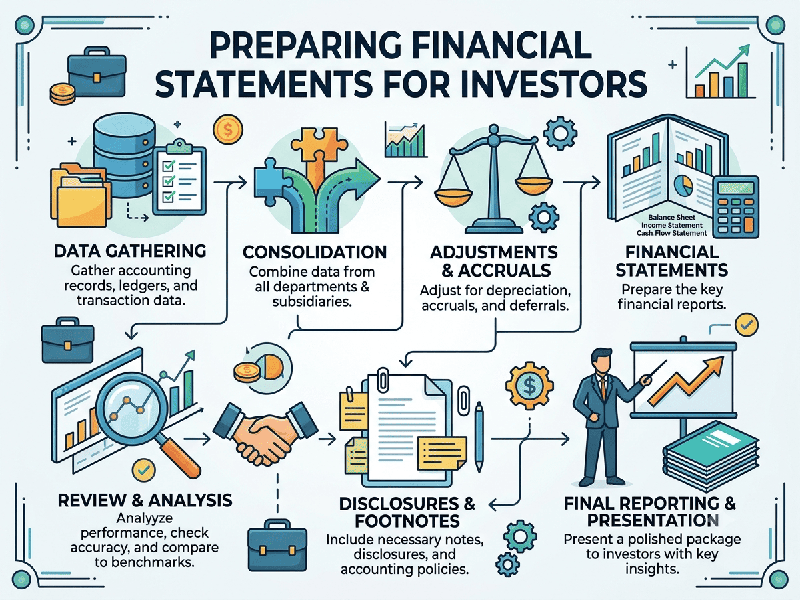
Preparing Financial Statements for Investors
Preparing financial statements for investors requires
presenting clear, standardized, and audit-ready financial data that
demonstrates past performance, current financial health, and future growth
potential.
1. The Core Financial Statements
Investors expect three primary statements prepared in
accordance with standard accounting principles (such as Ind AS / Indian GAAP in
India, or IFRS / US GAAP globally):
Income Statement (Profit & Loss Statement): Details revenues, costs, and
expenses over a specific period (monthly, quarterly, and annually). Investors
focus heavily on Gross Margin, Operating Income (EBITDA), and Net
Profit to evaluate unit economics and scalability.
Balance Sheet: Provides a snapshot of the company’s financial position at a
single point in time. It tracks Assets (cash, accounts receivable,
inventory, equipment), Liabilities (accounts payable, short-term and
long-term debt), and Shareholders’ Equity (paid-in capital, retained
earnings).
Cash Flow Statement: Tracks actual cash moving in and out of the business
across three categories: Operating Activities, Investing Activities,
and Financing Activities. For early-stage and growth companies, this is
critical for verifying monthly burn rate and cash runway.
2. Financial Projections (3 to 5 Years)
Alongside historical actuals (typically the past 2–3
years, if available), provide forward-looking projections:
Granularity: Show monthly projections for the next 12–24 months, and
quarterly or annual projections for years 3 through 5.
Bottom-Up Assumptions: Build revenue forecasts from
operational drivers (e.g., sales headcount, conversion rates, average contract
value, pricing tiers) rather than arbitrary top-down percentages.
Scenario Modeling: Present a Base Case (most likely outcome),
alongside a Conservative Case (slower growth/higher costs) and an Upside
Case.
3. Step-by-Step Preparation Checklist
Reconcile All Accounts: Ensure bank statements, credit
cards, GST/tax filings, and payroll records match your general ledger down to
the last rupee/dollar.
Separate Personal and Business Expenses: Remove any non-operating or founder
personal expenses (or clearly document them as one-time add-backs) so operating
margins reflect true business performance.
Standardize Revenue Recognition: Record revenue when earned (accrual
basis), not simply when cash hits the bank—especially important for annual
subscriptions, retainers, or milestone-based contracts.
Prepare a Cap Table: Pair your financial statements with an updated
Capitalization Table showing current ownership percentages, ESOP pools, and any
existing convertible notes or SAFEs.
Write Executive Notes (MD&A): Add brief commentary explaining
major variances, one-time expenses, seasonal fluctuations, and key assumptions
behind your projections.
4. Presentation Best Practices
Format Cleanly: Deliver financial models in an unlocked, dynamic spreadsheet
format (.xlsx or Google Sheets) with clearly separated tabs for Assumptions,
Historical Actuals, 3-Statement Projections, and KPIs. Use
a PDF executive summary for initial pitch decks.
Color-Code Inputs: Follow financial modeling standards—use blue font
for hardcoded inputs/assumptions, black font for formulas on the same
sheet, and green font for links to other tabs.
Verify Consistency: Ensure the numbers in your pitch deck slides match
your detailed financial model and tax filings without discrepancy.