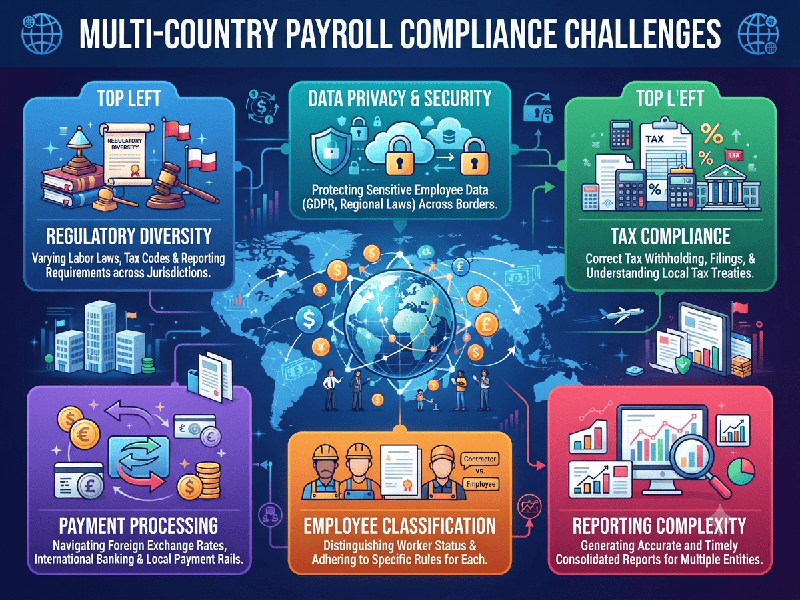
Multi-Country Payroll Compliance Challenges
Managing multi-country payroll compliance
requires harmonizing centralized corporate governance with hyper-local
statutory rules. As organizations expand across borders, fragmented
spreadsheets and disconnected local vendors quickly expose the business to
regulatory penalties, audit failures, and operational bottlenecks.
1. Divergent Tax, Social Security & Statutory
Frameworks
No two jurisdictions calculate gross-to-net pay the
same way, and statutory rules change continuously:
Localized Gross-to-Net Engines: Payroll teams must configure
country-specific income tax brackets, social security/pension contributions,
healthcare levies, and statutory deductions (for example, PF, ESIC, PT, and TDS
in India versus FICA in the US or PAYE/NIC in the UK).
Cross-Border Tax & Shadow Payroll: Employees working across
jurisdictions, remote international hires, or expatriates on secondment can
trigger dual tax withholding, social security totalization certificate
tracking, and Permanent Establishment (PE) risks if their work creates a
taxable corporate footprint abroad.
Statutory Reporting & Electronic Mandates: Filing cadences and formats vary
widely—from real-time payroll reporting (such as UK RTI or Single Touch
Payroll) to strict electronic wage files (such as Gulf WPS/Mudad systems).
2. Labor Law, Leave & Termination Variations
Payroll accuracy depends directly on local employment
legislation:
Working Hours, Overtime & Minimum Wage: Statutory workweeks, shift
differentials, overtime multipliers, and mandatory bonuses (such as 13th- or
14th-month pay in parts of Europe, Latin America, and Asia) differ across
regions.
Leave Accruals & Statutory Pay: Annual leave carryover limits,
parental leave funding (employer-paid vs. state-reimbursed), and public holiday
calendars must sync accurately with time-and-attendance systems.
Termination & Severance Rules: Notice periods, statutory severance
formulas, and End-of-Service Benefits (EOSB) vary dramatically and often
require strict separation between basic salary and allowances to avoid labor
disputes.
3. Fragmented Systems & Data Integration Friction
Many multinationals start with a patchwork of local
in-country providers (ICPs), leading to operational silos:
Manual Re-Keying & Latency: Transferring employee changes,
bonuses, and attendance via spreadsheets or flat files between a central HRIS
and local payroll engines creates human error and version mismatches.
Lack of Consolidated Financial Visibility: Finance teams often spend days
manually reconciling disparate local payroll registers into a single General
Ledger (GL) format to understand true global labor costs.
4. Multi-Currency Treasury & Banking Rails
Paying a global workforce involves navigating complex
banking infrastructure and foreign exchange (FX) exposure:
Local Currency & In-Country Accounts: Many countries mandate that salaries
be paid in local currency through locally licensed bank accounts or clearing
systems.
FX Volatility & Cut-Off Windows: Managing exchange rate lock-ins,
cross-border wire fees, and staggered banking holidays across time zones is
critical to prevent late salary disbursements.
5. Data Privacy, Security & Entity Governance
Cross-Border Data Laws: Payroll data contains highly
sensitive Personally Identifiable Information (PII) and banking details. Moving
employee records across borders must comply with data localization mandates and
privacy regulations such as GDPR, SOC 2 Type II, and ISO 27001 standards.
Worker Misclassification: Engaging international talent as
independent contractors instead of employees—or hiring without a local legal
entity or compliant Employer of Record (EOR)—can trigger back taxes, statutory
benefit liabilities, and regulatory fines.