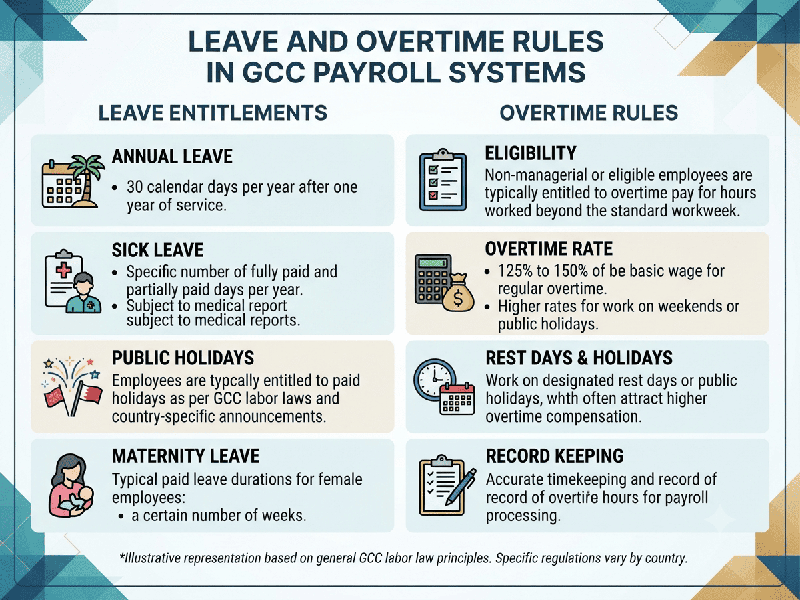
Leave and Overtime Rules in GCC Payroll Systems
Configuring leave and overtime rules in GCC payroll
systems requires encoding distinct statutory formulas for each member
state—Bahrain, Kuwait, Oman, Qatar, Saudi Arabia, and the UAE—rather than
applying a single regional template. Payroll engines must handle strict Ramadan
hour reductions, tiered sick-leave pay slabs, basic-vs-gross wage bases, and
Wage Protection System (WPS) compliance.
1. Working Hours & Ramadan Schedule Logic
Standard private-sector schedules across most GCC
countries cap working hours at 8 hours/day and 48 hours/week (with Oman
setting a 40-hour standard week under Royal Decree 53/2023).
Mandatory Ramadan Reduction: During the holy month of Ramadan,
statutory daily working hours drop to 6 hours/day (36 hours/week).
Payroll System Rule: In countries like the UAE and Oman,
this reduction applies to all employees regardless of faith, whereas in
jurisdictions such as Saudi Arabia and Qatar, the statutory
reduction applies specifically to Muslim employees. Any work performed
past the 6-hour threshold triggers overtime rates without reducing base pay.
Maximum Overtime Caps: Payroll and time-and-attendance
modules must enforce statutory ceilings—for instance, 2 overtime hours per
day (and 144 total hours over any 3-week period) in the UAE, 720
overtime hours per year in Saudi Arabia, and 2 hours/day, 3 days/week,
and 90 days/year in Kuwait.
2. Overtime Calculation Formulas & Premium
Multipliers
A primary source of labor disputes and audit failures
in Gulf payroll is using the wrong wage base or day-count divisor:
Wage Base (Basic vs. Gross): Most GCC jurisdictions—including the
UAE, Qatar, Bahrain, and Oman—calculate overtime strictly on Basic
Salary (excluding housing, transport, and utility allowances). Saudi
Arabia, however, requires a 150% (1.5×) premium calculated on the basic
hourly wage plus 50% of actual wage (effectively adding 50% of the basic
wage on top of the full gross hourly rate).
Standard Hourly Divisor: Monthly-paid salaries are typically
converted using a 30-day month (Monthly Wage ÷ 30 ÷ 8 = Standard Hourly
Rate), though some payroll configurations use Annual Wage ÷ 365 ÷ 8 depending
on contract wording and local ministry guidance.
Night, Rest Day & Holiday Multipliers:
Normal Weekday Overtime: 1.25× in the UAE, Kuwait,
Qatar, and Bahrain; 1.50× in Saudi Arabia.
Night Shifts: 1.50× in the UAE (10:00 PM – 4:00 AM), with specific
night-window premiums in Oman and Bahrain.
Weekly Rest Days & Public Holidays: 1.50× (plus a compensatory
day off, or 2.00× if no substitute day off is granted) in the UAE and
Kuwait, while Saudi Arabia treats all work on official Eid and National
holidays as mandatory overtime.
3. Annual Leave Accrual, Encashment & Wage Basis
Statutory Entitlements:
30 calendar/working days per year: UAE (after 1 year of service; 2
days/month between 6 and 12 months), Oman (30 working days), Kuwait (30 working
days after 6 months), and Bahrain (30 days after 1 year).
Tiered by Tenure: Saudi Arabia grants 21 days/year for the first
5 years, rising to 30 days/year thereafter. Qatar grants 3 weeks (21
days) for under 5 years, rising to 4 weeks (28 days) from year 5
onward.
Leave Salary vs. Leave Encashment:
Paid Leave Taken: Paid at full gross wage (basic salary + fixed
allowances) in advance before leave begins.
Unutilized Leave Encashment (at Exit): Typically calculated on basic
salary only under UAE and several neighboring labor laws unless the
employment contract stipulates gross pay.
Calendar vs. Working Days: Payroll engines must track whether
statutory leave is counted in calendar days (including weekends/holidays
falling inside the leave block, as in the UAE and Saudi Arabia) or working
days (excluding weekends/holidays, as in Kuwait and Oman).
4. Tiered Sick Leave & Special Statutory Leaves
GCC payroll systems cannot treat sick leave as a flat
paid balance; they must automate progressive pay-reduction slabs tied to
a medical certificate:
UAE & Bahrain (up to 90 days/year): First 15 days at 100% pay,
next 30 days at 50% pay, and remaining 45 days at 0%
(unpaid).
Saudi Arabia (up to 120 days/year): First 30 days at 100% pay,
next 60 days at 75% pay, and final 30 days at 0%
(unpaid).
Kuwait (up to 75 days/year): First 15 days at 100%, next 10 days
at 75%, next 10 days at 50%, next 10 days at 25%, and final 30 days unpaid.
Special Leaves: Systems must also configure zero-deduction balances for Hajj
pilgrimage leave (typically 10–15 days once during employment for Muslim
staff), maternity leave (ranging from 45 to 70+ days depending on
country), paternity/parental leave (e.g., 5 working days in the UAE, 3
days in Saudi Arabia), and bereavement/Iddah leave.