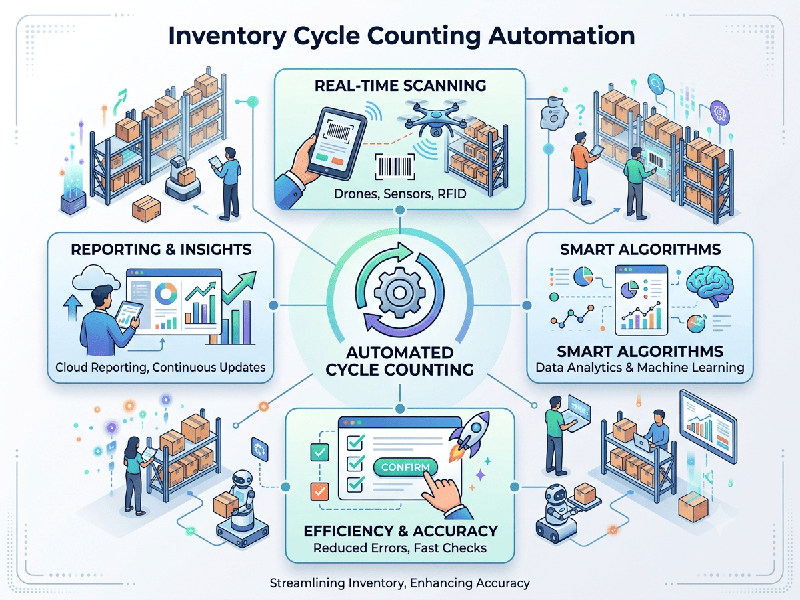
Inventory Cycle Counting Automation
Inventory Cycle Counting Automation is the process of using technology
to perform rolling, continuous audits of stock levels without the need for
facility-wide shutdowns. In 2026, this has evolved from manual barcode scanning
to high-frequency, sensor-driven workflows that keep digital inventory records
within 99%+ accuracy of physical reality.
Core Enabling Technologies
To achieve "perpetual" inventory visibility,
2026 operations leverage a blend of these three technologies:
- Computer Vision & Robotics: Camera-mounted forklifts or
reach trucks scan entire rack faces in a single pass. Some facilities
utilize "Bin AMRs" (Autonomous Mobile Robots) that bring
inventory directly to a stationary workstation for
"Goods-to-Person" counting, eliminating the need to search
aisles.
- Mobile-First WMS Integration: Modern ERP and WMS (Warehouse
Management System) mobile apps guide workers through "Blind
Counts." In this method, the system asks the user for the quantity without
showing the expected number, preventing bias and ensuring the count is
genuine.
- Sensor-Agnostic AI: New software platforms
integrate with existing ERP/MRO databases without requiring proprietary
hardware or expensive infrastructure overhauls, allowing mid-sized
"brownfield" facilities to deploy in under 14 days.
Strategic Frameworks for 2026
Automated systems rely on algorithmic scheduling
rather than static calendars:
1.
ABC Analysis:
High-value or high-velocity items (Category A) are flagged for daily or weekly
automated checks, while lower-impact items (Category C) are counted less
frequently.
2.
Opportunity-Based Counting: Instead of rigid schedules, the system triggers a count
during "natural lulls"—such as when a piece of equipment is idling,
during shift changes, or immediately after a pick/putaway task.
3.
Predictive Auditing: Advanced AI analyzes usage patterns, expiration dates, and error history
to prioritize counts for items most at risk of shrinkage or discrepancy, rather
than counting randomly.