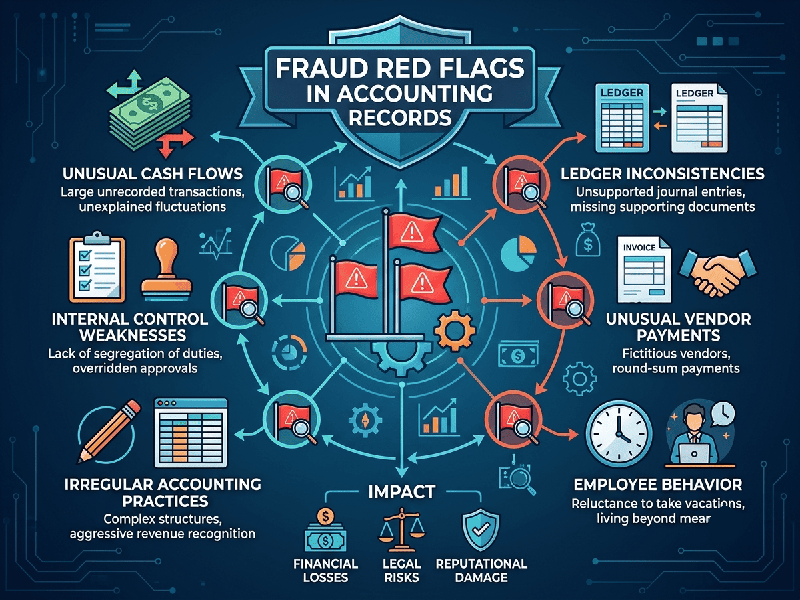
Fraud Red Flags in Accounting Records
Accounting red flags are operational anomalies,
unusual transactions, or pattern breaks that signal potential fraud,
misstatement, or internal control breakdowns. Recognizing these indicators
early helps finance teams and auditors prevent asset misappropriation and
fraudulent financial reporting.
1. General Ledger & Journal Entry Anomalies
Timing & Frequency Flaws:
High volume of manual journal entries created at
night, on weekends, or during period-end closing hours.
Adjusting entries made immediately prior to financial
statement issuance without supporting documentation.
Suspicious Entry Structure:
Entries posted to suspense, obscure, or rarely used
accounts.
Frequent round-number transactions (e.g., $10,000,
$50,000) where exact figures are typically expected.
Unbalanced journal entries or entries bypassing
standard review workflows.
2. Accounts Payable & Vendor Disbursement Flags
Vendor Master File Vulnerabilities:
Vendor addresses matching employee home addresses or
listed as P.O. Boxes without physical office locations.
New vendors receiving unusually high payment volumes
shortly after setup.
Multiple vendors sharing identical bank account
details or tax registration numbers.
Invoice & Payment Irregularities:
Consecutive or sequentially numbered invoices from the
same vendor over extended periods.
Invoices lacking standard business details (e.g.,
phone numbers, tax IDs, itemized service descriptions).
Recurring payment amounts deliberately set just below
mandatory approval or dual-signature thresholds (e.g., $4,999 when approval is
required at $5,000).
3. Revenue Recognition & Accounts Receivable Red
Flags
Aggressive Sales Postings:
A dramatic surge in sales volume during the final days
of a quarter or fiscal year, followed by heavy credit notes or returns in the
new period.
Invoices booked without signed customer purchase
orders, shipping documentation, or proof of delivery.
Collections & Aging Distortions:
Accounts receivable balances growing significantly
faster than total revenue.
Reclassifications of overdue balances to prevent them
from showing up on aging reports.
Unexplained write-offs of bad debts for specific
high-value clients.
4. Cash, Banking & Reconciliation Anomalies
Bank Reconciliation Irregularities:
Long-outstanding uncleared checks or deposits in
transit carried month after month without resolution.
Reconciliations prepared with unexplained
"balancing" or "adjustment" line items.
Cash Flow Disconnects:
Persistent divergence between reported net income
(growing) and actual operating cash flows (declining or stagnant).
Frequent transfers between multiple corporate bank
accounts near month-end (potential kiting to artificially inflate cash
balances).
5. Payroll & Inventory Safeguard Flags
Payroll Red Flags:
Direct deposit payouts routed to the same bank account
for multiple non-related employees.
Active payroll disbursements to individuals missing
complete tax IDs, formal contracts, or HR files.
Inventory & Asset Discrepancies:
Recurring write-downs or inventory shrinkage entries
without corresponding incident or security reports.
Discrepancies between physical inventory count sheets
and general ledger balances.