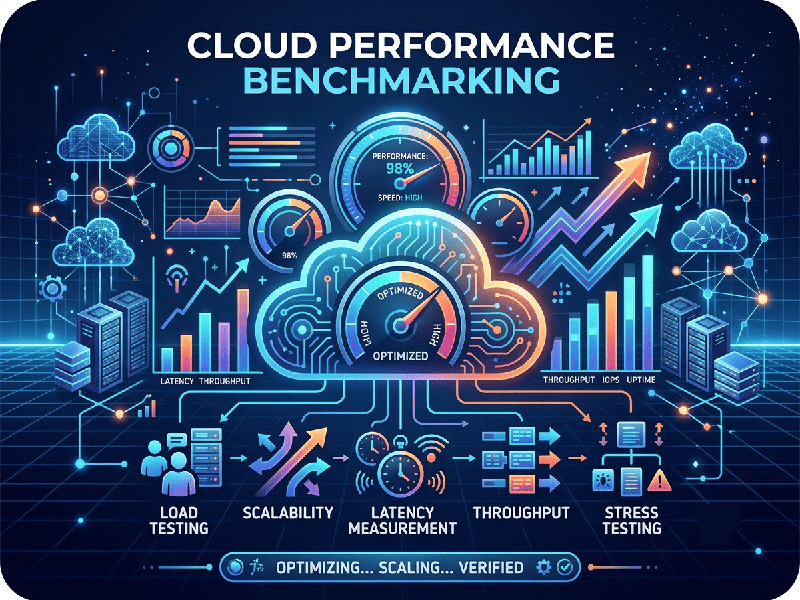
Cloud Performance Benchmarking
Cloud performance benchmarking in 2026 has shifted
from simple cost-saving exercises to value-based governance. Because
cloud environments are now complex, AI-driven, and multi-cloud, benchmarking is
no longer just about measuring speed—it is about validating business impact,
resilience, and financial efficiency simultaneously.
1. The 2026 Shift: Value over Speed
- Unit Economics: Success is now measured by cost
per service or unit economics rather than just total cloud spend.
Companies are linking cloud consumption directly to business outcomes
(e.g., ROI per transaction).
- Convergence of Observability
& Security:
Performance and security are now treated as one. Degradation and
misconfigurations often share the same root cause (policy inconsistency).
Modern benchmarking includes continuous posture assurance—checking
configurations against business intent in real-time.
- FinOps Evolution: "Agentic FinOps" is
emerging, where autonomous AI agents actively execute cost optimizations
based on real-time performance telemetry.
2. Key Performance Metrics for 2026
When benchmarking, move beyond legacy response-time
checks to these strategic metrics:
- Business-Critical Workflow
Latency:
Mapping performance to specific user journeys (e.g., "Add to
Cart" time) rather than generic page load speeds.
- Cost-per-Workload Efficiency: Measuring the operational cost
of specific AI/ML tasks or microservices under varying load levels.
- Resilience & Recovery Time: Benchmarking how quickly
services recover from chaos experiments (fault injection) under
production-like conditions.
- Autoscaling Precision: Measuring the "lag
time" between a traffic spike and the system’s ability to scale
resources effectively without over-provisioning.
3. Best Practices for Modern Environments
- Perform
"Production-Like" Testing: Avoid benchmarking in isolated dev environments.
Use production-mirror environments or synthetic traffic injection to get
accurate data on how cloud services behave at scale.
- Implement Chaos Engineering: Safely inject faults (e.g.,
terminating a service or throttling a database) to measure your system's
"blast radius" and recovery speed.
- Standardize Governance: Treat infrastructure as code
(IaC) and run automated regression checks against security and performance
policies every time you deploy.
- Focus on Edge-to-Cloud Flow: As edge computing grows, ensure
your benchmarks measure latency not just from the data center, but from
the perspective of the end-user or edge device.