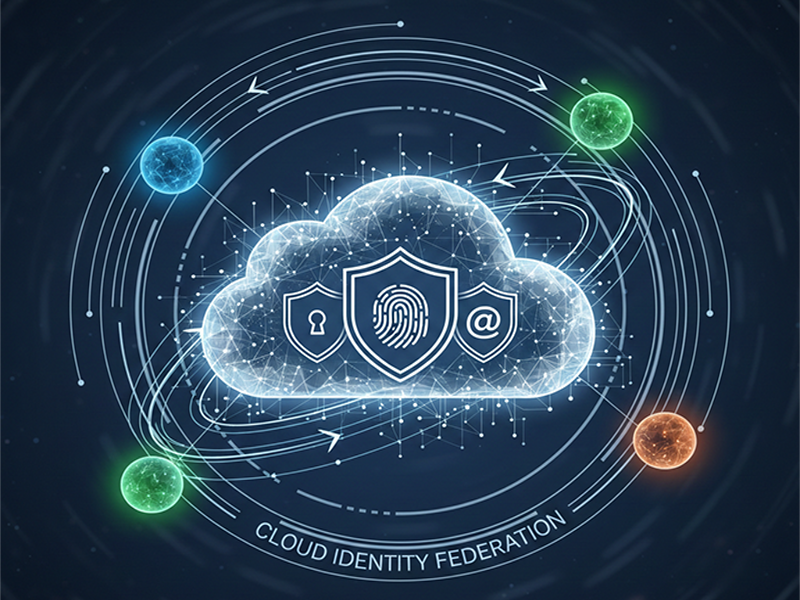
Cloud Identity Federation
Cloud
Identity Federation is
a standardized method of linking a user's single digital identity across
multiple distinct security domains or cloud service providers. By 2026, it has
become the backbone of scalable access management in multi-cloud architectures,
enabling users to authenticate once with a trusted Identity Provider
(IdP) and gain access to multiple Service Providers (SPs) without
managing separate credentials for each.
How It
Works (Process Flow)
The system
relies on a "trust relationship" established between the IdP
(e.g., Okta, Microsoft
Entra ID) and the SP (e.g., AWS, Salesforce).
1.
Request: A
user or workload attempts to access a cloud service.
2.
Redirection: The
service redirects the request to the designated IdP for authentication.
3.
Authentication: The
user logs in at the IdP (using biometrics, passwords, or passkeys).
4.
Token Issuance: Once
verified, the IdP generates a secure digital token (assertion).
5.
Access Granted: The
SP validates this token and grants access based on pre-defined authorization
policies.
Key Types
of Federation in 2026
- Workforce Identity Federation: Connects employees and
partners to cloud resources using their existing corporate credentials
without synchronizing user accounts to every cloud platform.
- Workload Identity Federation: Enables non-human
identities, such as CI/CD pipelines or containers, to access cloud
services securely using short-lived tokens instead of permanent, high-risk
security keys.
Primary
Protocols & Technologies
- SAML 2.0: An XML-based standard for
exchanging authentication data, commonly used in large enterprise
environments.
- OAuth 2.0: A framework primarily
for authorization, allowing services to share data without
sharing passwords.
- OpenID Connect (OIDC): An identity layer built on
top of OAuth 2.0, widely used for modern web and mobile authentication.
- SCIM: A protocol that automates
the provisioning and management of user identities across different
domains.