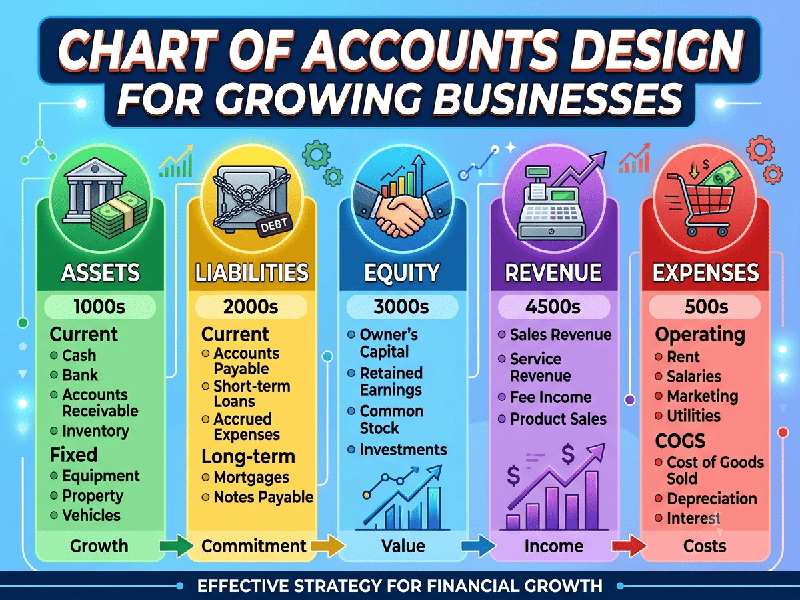
Chart of Accounts Design for Growing Businesses
A well-designed Chart of Accounts (COA) acts as
the financial backbone of a growing business. It serves as an organized
directory of every financial account in your general ledger, classifying
assets, liabilities, equity, revenue, and expenses so you can generate precise
financial statements and management reports.
As a business scales, an unstructured COA leads to
messy reconciliation, blind spots in profitability, and reporting bottlenecks.
Step-by-Step Blueprint for Growing Businesses
1. Assets (1000s) — Liquidity and Resources
Keep current assets separate from long-term capital
assets to accurately measure liquidity and working capital.
1100 Cash & Cash Equivalents (Operating accounts, petty cash,
merchant gateways like Stripe/PayPal)
1200 Accounts Receivable (Invoices awaiting client payment)
1300 Allowance for Doubtful Accounts (Contra-asset for bad debt)
1400 Inventory / Stock on Hand
1500 Prepaid Expenses (Insurance, annual software subscriptions
paid upfront)
1800 Fixed Assets (Equipment, computers, office furniture)
1850 Accumulated Depreciation
2. Liabilities (2000s) — Obligations and Debt
Distinguish between short-term obligations due within
a year and long-term financing.
2100 Accounts Payable (Bills owed to vendors and suppliers)
2200 Corporate Credit Cards
2300 Accrued Expenses (Payroll accrued, unpaid bonuses)
2400 Sales Tax / GST Payable (Collected taxes due to government
authorities)
2500 Short-Term Loans / Working Capital Lines
2700 Long-Term Debt (Term loans, equipment financing)
3. Equity (3000s) — Net Worth
3100 Owner's Capital / Common Stock
3200 Owner's Draws / Distributions
3900 Retained Earnings (Accumulated net income from prior years)
4. Revenue (4000s) — Streamlining Income Streams
Avoid grouping all sales into one catch-all account.
Segment revenue streams to track which products, services, or divisions drive
growth.
4100 Product Sales (Broken down by major product category if
applicable)
4200 Service / Consulting Revenue
4300 Subscription / Recurring Revenue (MRR/ARR streams)
4900 Other Revenue (Interest income, currency exchange gains)
5. Cost of Goods Sold - COGS (5000s) — Direct Expenses
These fluctuate directly with sales volume. Tracking
them separately from overhead is essential for calculating Gross Profit
Margin.
5100 Direct Materials / Raw Materials
5200 Direct Labor (Contractors or staff dedicated to fulfillment)
5300 Merchant Processing Fees (Stripe, PayPal, credit card
transaction fees)
5400 Shipping, Freight, and Fulfillment Costs
6. Operating Expenses - OpEx (6000s to 8000s) —
Overhead
Group overhead expenses logically so management can
review department-level or functional spending.
Payroll & People (6000s): Salaries, employer payroll taxes,
health insurance, recruitment.
Facilities & Technology (7000s): Rent, utilities, cloud software
subscriptions (ERP, CRM, workspace tools), IT infrastructure.
Marketing & Growth (8000s): Digital advertising, SEO/content
agencies, travel, entertainment, professional fees (legal, accounting,
compliance).
Best Practices for Designing and Scaling Your COA
Leave Room for Growth: Do not number accounts consecutively
(e.g., 6001, 6002, 6003). Leave gaps of 5 or 10 digits between accounts (e.g.,
6100, 6110, 6120) so you can insert new sub-accounts later without breaking
your numerical sequence.
Leverage Tracking Categories (Classes/Dimensions): Instead of creating hundreds of
individual accounts for every department or geographical location use modern accounting
software's "Classes," "Locations," or "Tracking
Categories." Keep your core COA clean and use dimensions for granular
slicing.
Avoid Over-Granularity: Don't create an account for every
minor expense. If an expense type makes up less than 1% of your total budget
and doesn't require separate tax or regulatory tracking, group it into a
broader "General Office Supplies" or "Miscellaneous"
category.
Consistency is King: Once your COA is established and mapped to your
financial reporting software, restrict account creation permissions. Only
designated finance leads or your CPA should add new general ledger accounts to
prevent duplicate or misclassified entries.