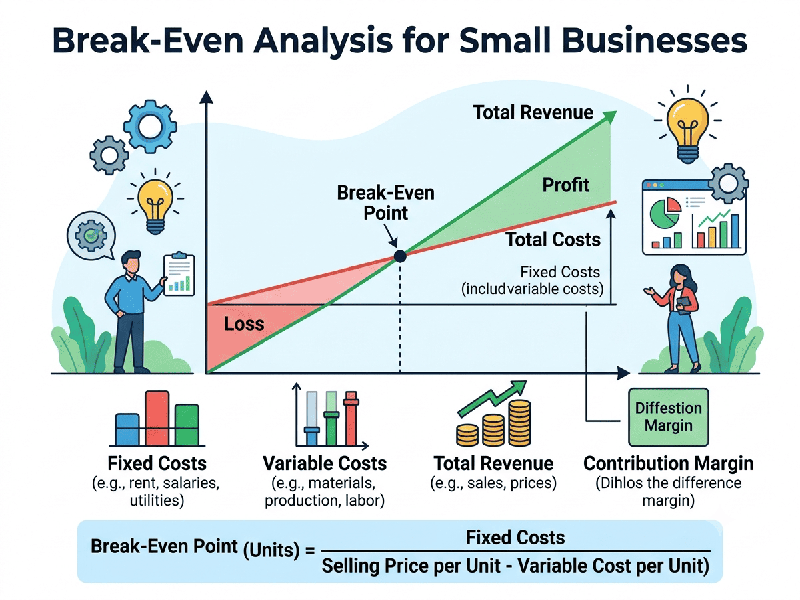
Break-Even Analysis for Small Businesses
A break-even analysis identifies the exact
point where a small business’s total revenue equals its total costs—meaning
there is neither profit nor loss. Calculating this threshold establishes the
minimum sales volume required to keep the business financially viable and guides
pricing, cost-control, and expansion decisions.
1. Core Components
To calculate the break-even point (BEP), separate all
business expenses into two categories:
Fixed Costs: Overhead expenses that remain constant regardless of
production or sales volume (e.g., commercial rent, full-time salaries,
insurance, software subscriptions, loan EMIs).
Variable Costs: Direct expenses that fluctuate directly with each unit
produced or sold (e.g., raw materials, packaging, direct hourly labor,
shipping, payment gateway fees).
Selling Price per Unit: The retail price charged to a
customer for a single product or service unit.
Contribution Margin: The amount each unit sale contributes toward covering
fixed costs after paying for its own variable expenses (
2. Break-Even Formulas
Depending on whether you track inventory by physical
units or overall revenue, use one of two primary formulas:
A. Break-Even Point in Units
B. Break-Even Point in Revenue (Sales Value)
4. Strategic Applications for Small Businesses
Pricing Validation: Reveals whether current pricing can realistically
cover overhead at achievable sales volumes. If the break-even unit count
exceeds market capacity, prices must increase or costs must drop.
Expense Control: Shows the immediate impact of cutting fixed overhead
versus negotiating lower supplier rates on variable materials.
Margin of Safety: Measures how much sales can drop before the business
incurs a loss:
New Product or Expansion Decisions: Evaluates how many additional sales
are needed to justify purchasing new equipment, hiring staff, or opening a
second location.
5. Common Pitfalls to Avoid
Misclassifying Semi-Variable Costs: Utilities, maintenance, and overtime
wages have both fixed base charges and usage-based spikes; split them
accurately rather than lumping them entirely into one category.
Ignoring Hidden Overhead: Forgetting annual taxes, equipment
depreciation, marketing spend, or owner compensation artificially lowers your
break-even target.
Assuming Static Prices and Costs: Raw material inflation, seasonal
discounting, and bulk supplier tiers shift your break-even point—recalculate
quarterly.