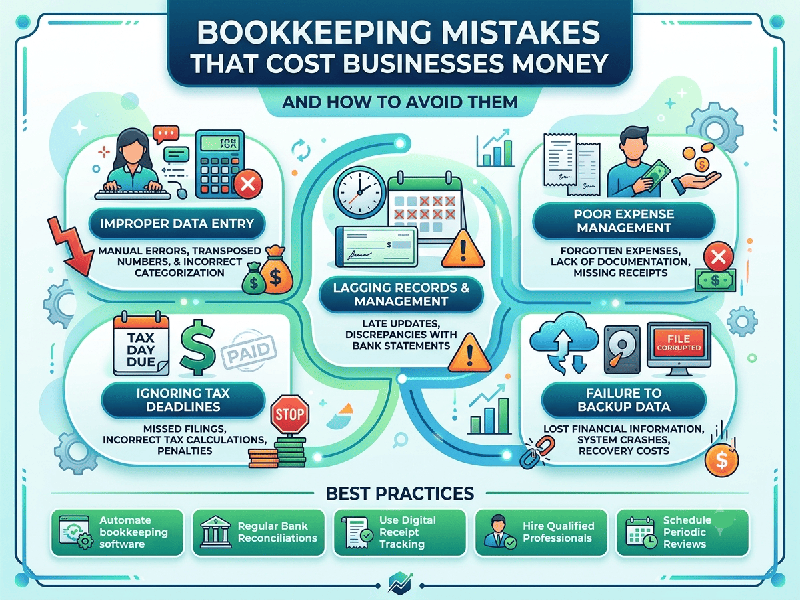
Bookkeeping Mistakes That Cost Businesses Money
In-Depth Breakdown of Costly Mistakes
1. Co-Mingling Personal and Business Funds
The Error: Using corporate accounts or credit cards for personal
purchases (or vice versa) without logging explicit owner draw/capital
contribution entries.
The Cost: Pierces corporate veil protections, complicates tax filings,
increases accounting fees during year-end cleanup, and risks disallowance of
valid business deductions during tax audits.
2. Misclassifying Capital Assets as Immediate Expenses
The Error: Expense-booking high-value equipment, vehicles, or software
development outright instead of capitalizing them to the Balance Sheet.
The Cost: Distorts your profit and loss (P&L) statement for the
current period, distorts gross margins, and violates statutory accounting
standards (such as Ind AS / AS / GAAP) for asset depreciation.
3. Poor Invoice Management & Untracked AR Aging
The Error: Delaying invoice creation, failing to send automated payment
reminders, or neglecting monthly Accounts Receivable aging reports.
The Cost: Increases the cost of capital, starves operational
liquidity, and drastically lowers the probability of recovering aged debts.
4. Neglecting Vendor Invoice Matching (AP Errors)
The Error: Paying supplier invoices without three-way matching
(Purchase Order + Goods Receipt Note + Vendor Invoice).
The Cost: Duplicate payments for single shipments, paying for damaged
or unreceived goods, and missed early-payment supplier discounts.
5. Mismanaging Sales Tax & Indirect Tax
Reconciliations
The Error: Failing to reconcile GST/VAT liability accounts with actual
sales registers, or missing Input Tax Credit (ITC) reversal rules.
The Cost: Incurring statutory interest, late filing penalties, and
losing valuable tax credits due to mismatched filings (e.g., GSTR-3B vs.
GSTR-2B discrepancies).
6. Infrequent Bank & Credit Card Reconciliations
The Error: Reconciling ledger bank balances only quarterly or during
year-end close.
The Cost: Unidentified bank errors, recurring unauthorized
subscription renewals, delayed detection of employee fraud or skimming, and
inaccurate cash reporting for management decisions.