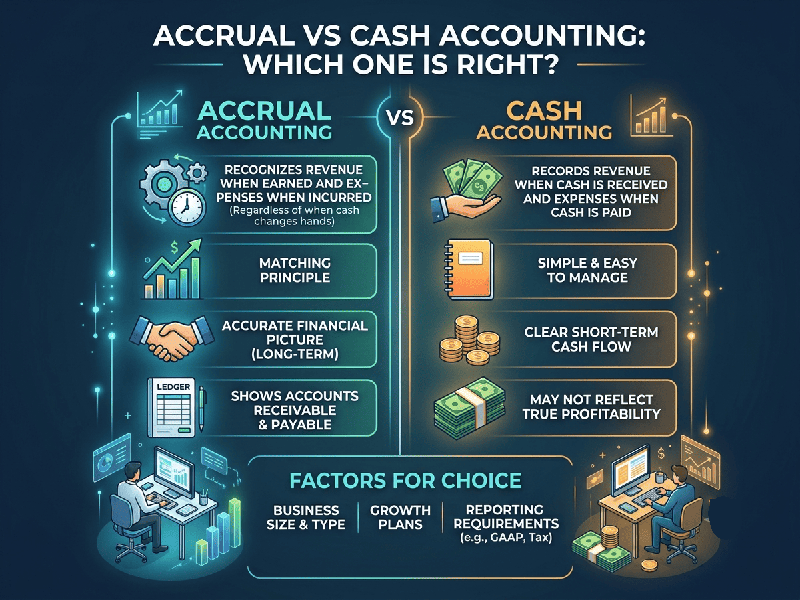
Accrual vs Cash Accounting: Which One Is Right?
Choosing between cash accounting and accrual
accounting comes down to how and when you record revenues and expenses. The
right choice depends on your business size, legal structure, inventory
requirements, and reporting needs.
1. Cash Basis Accounting
In cash accounting, transactions are recorded only
when cash actually changes hands.
Revenue: Recorded when you receive payment from a client or customer
(the money is in your bank or hand).
Expenses: Recorded when you actually pay a bill or vendor.
Best for: Very small businesses, freelancers, sole proprietors, and
service-based businesses with no inventory and simple cash flow needs.
Advantages: Simpler to track, gives a clear picture of exact cash on
hand, and taxes are only paid on money actually collected.
Disadvantages: Does not show long-term profitability, accounts receivable
(money owed to you), or accounts payable (bills you owe). It can make a
profitable month look disastrous just because clients paid late.
2. Accrual Basis Accounting
In accrual accounting, revenues and expenses are
recorded when they are earned or incurred, regardless of when the money
actually moves.
Revenue: Recorded when you deliver a service or ship a product
(typically when you issue the invoice).
Expenses: Recorded when you receive a bill or incur a liability, even
if you pay it later.
Best for: Growing businesses, companies carrying inventory, firms with
significant credit sales (accounts receivable), and registered corporate
entities (such as LLPs and private limited companies).
Advantages: Provides an accurate, realistic picture of financial health
and profitability over a specific period; required by standard accounting
frameworks (GAAP/IFRS) and corporate laws in many jurisdictions.
Disadvantages: More complex to maintain, requires accounting software, and
can create tax liabilities on revenue that has been invoiced but not yet
collected (leading to temporary cash flow crunches).
Which One Is Right?
To determine which method fits your situation,
consider the following factors:
Legal Structure & Compliance: If your business is structured as a
corporate entity or Limited Liability Partnership (LLP), regulatory frameworks
(such as the Indian Companies Act or standard tax provisions for corporate
entities) typically mandate accrual accounting for statutory audits and
financial reporting.
Inventory & Credit: If you sell physical products,
maintain inventory, or routinely extend credit payment terms to clients
(requiring accounts receivable), accrual accounting is necessary to
properly match expenses with related sales.
Simplicity vs. Insight: If you operate a small freelance
consultancy or boutique service firm with immediate payments and zero
inventory, cash accounting offers straightforward record-keeping without
tracking complex receivables.