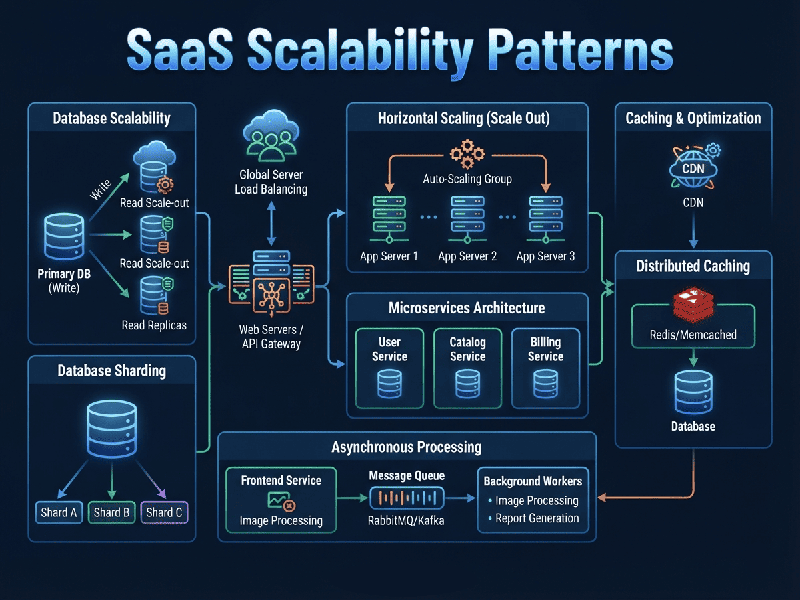
SaaS Scalability Patterns
SaaS scalability is the architectural and operational
capability of a software application to handle growing volumes of users,
traffic, and data seamlessly without degrading performance, availability, or
inflating unit economics. Implementing proven architectural patterns ensures
your platform can scale horizontally as demand increases.
1. Data Architecture & Multi-Tenancy Patterns
- Database Sharding: Horizontally partition large
datasets across multiple database instances based on a shard key (such as
tenant ID or geographic region) to bypass single-server I/O bottlenecks.
- Tenant Isolation Strategies: Choose the right multi-tenancy
model based on enterprise security needs—ranging from shared database
with shared schema (cost-effective) to isolated databases per
enterprise tenant (high security and compliance).
- Read Replicas & CQRS: Separate Command Responsibility
Segregation (CQRS) and route heavy read queries to dedicated read
replicas, keeping primary database nodes optimized exclusively for write
transactions.
2. Microservices & Distributed Compute Patterns
- Service Decomposition: Break monolithic codebases into
loosely coupled microservices owned by independent teams, allowing
high-demand modules (like billing or notification engines) to scale
independently.
- Stateless Application Servers: Ensure application layers
remain completely stateless. Store session data, user context, and
authentication tokens in distributed caching layers (e.g., Redis) so any
server can handle any incoming request.
- Asynchronous Event-Driven
Architecture:
Decouple heavy background tasks (such as report generation, data imports,
or webhook dispatches) from the request-response cycle using message
brokers (e.g., Kafka, RabbitMQ).
3. Caching & Performance Acceleration Patterns
- Multi-Layered Caching: Implement caching at multiple
tiers—including browser/client-side caching, Content Delivery Networks
(CDNs) for static assets, distributed in-memory caches (Redis/Memcached)
for query results, and database-level query caching.
- Database Indexing & Query
Optimization:
Continuously monitor execution plans and apply strategic indexing on
frequently filtered foreign keys and tenant identifiers.
- Edge Computing: Leverage edge workers and
global CDNs to execute lightweight logic and cache API responses closer to
the end-user's geographic location.
4. Infrastructure & Auto-Scaling Resilience
Patterns
- Elastic Infrastructure &
Auto-Scaling:
Utilize cloud-native container orchestration (e.g., Kubernetes) with
Horizontal Pod Autoscalers (HPA) to automatically spin up or terminate
server instances based on real-time CPU, memory, or custom queue-depth
metrics.
- Circuit Breakers & Graceful
Degradation:
Implement circuit breaker patterns to prevent cascading failures when a
downstream dependency or third-party API goes down, ensuring core SaaS
functionality remains available.
- Load Balancing & Global
Traffic Management: Distribute incoming traffic evenly across multiple availability
zones or cloud regions using intelligent load balancers to ensure high
availability (99.99% uptime).