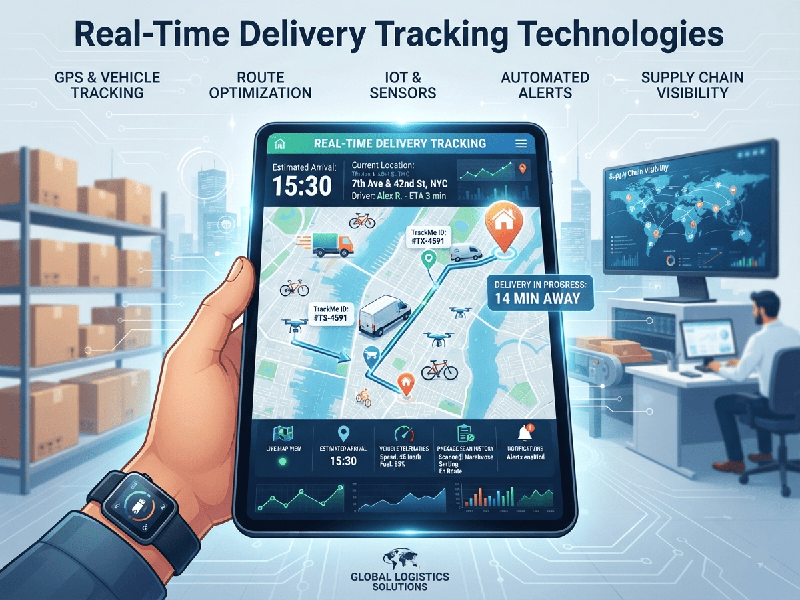
Real-Time Delivery Tracking Technologies
Real-time delivery tracking technologies comprise the
hardware, software, and communication protocols used to monitor the exact live
location, status, and condition of shipments, vehicles, and assets as they move
through the supply chain. Moving far beyond basic milestone scanning, modern
tracking provides complete end-to-end visibility from the warehouse floor to
the customer's doorstep.
Core Hardware and Data Technologies
1.
GPS and GNSS (Global Navigation Satellite Systems):
o Provides precise, up-to-the-minute
geographical coordinates for transport vehicles and high-value cargo.
2.
IoT Sensors (Internet of Things):
o Compact, connected devices embedded
in packaging or containers that track not just location, but environmental
conditions like temperature, humidity, shock/impact, and light exposure
(critical for pharmaceuticals, perishables, and fragile goods).
3.
RFID and Barcode Scanning:
o Used heavily in warehouses and
fulfillment centers for rapid check-ins, inventory tracking, and handoffs
before parcels enter transit vehicles.
4.
Cellular and Low-Power Wide-Area Networks (LPWAN):
o Technologies like 4G, 5G, LTE-M, and
NB-IoT transmit tracking data continuously over cellular networks while
preserving hardware battery life.
Enterprise Software and Intelligence Layers
- Supply Chain Visibility
Platforms: Cloud
systems (such as Project44, FourKites, and Descartes MacroPoint) aggregate
data across multiple carrier networks to offer a unified live dashboard.
- AI and Predictive ETAs: Machine learning models analyze
live traffic, weather data, historical transit times, and driver behavior
to dynamically update Estimated Times of Arrival (ETAs).
- TMS and ERP Integrations: Transportation Management
Systems and Enterprise Resource Planning tools sync live tracking feeds
directly with inventory, billing, and customer notification engines.