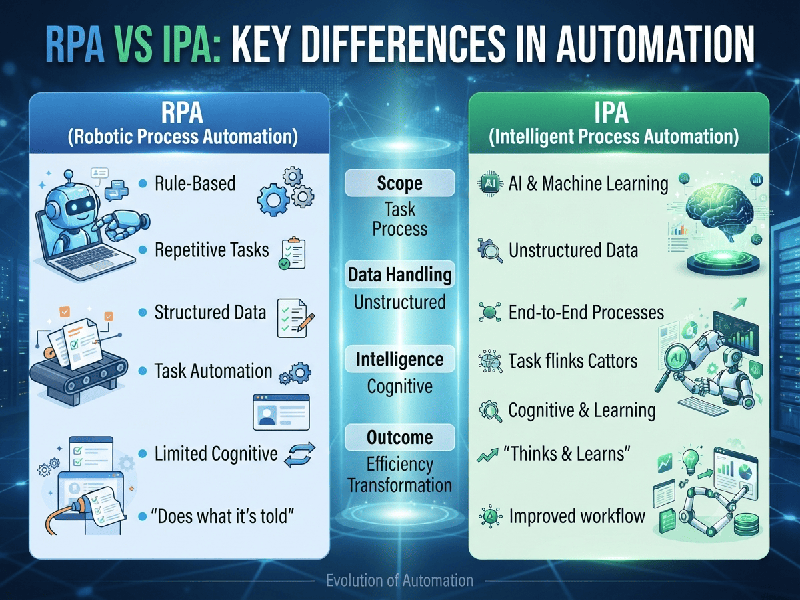
RPA vs IPA: Key Differences
While both Robotic Process Automation (RPA) and
Intelligent Process Automation (IPA) are designed to streamline business
operations and reduce manual workloads, they operate at fundamentally different
levels of complexity.
Deep Dive into the Key Differences
1. How They Handle Data
- RPA: Bots can only read data if it
is perfectly formatted and located exactly where the bot expects it to be.
If a supplier sends an invoice in a slightly different format, the RPA bot
will likely fail or flag an exception.
- IPA: Utilizing technologies like
Optical Character Recognition (OCR) and Natural Language Processing (NLP),
IPA can extract meaning from unstructured formats. It can read a messy
email from a vendor, understand that it contains an invoice, and extract
the relevant ₹ (Rupee) amounts, dates, and vendor details regardless of
the layout.
2. Rules-Based vs. Judgment-Based
- RPA: Operates strictly on rules. Example:
"Copy the value from Cell A1, open the ERP system, and paste it into
Field B."
- IPA: Applies judgment based on
historical data and AI models. Example: Reviewing a customer
support ticket, determining the customer's sentiment (angry vs.
inquiring), categorizing the issue, and suggesting a personalized
resolution before routing it to the right department.
3. The Learning Curve
- RPA: Does not learn. A bot will do
exactly what it is programmed to do on day 1,000 in the exact same way it
did on day 1.
- IPA: Employs Machine Learning. When
an IPA system encounters an exception it can't solve, it routes it to a
human. The system then monitors how the human resolves the issue and
learns to handle similar exceptions autonomously in the future.