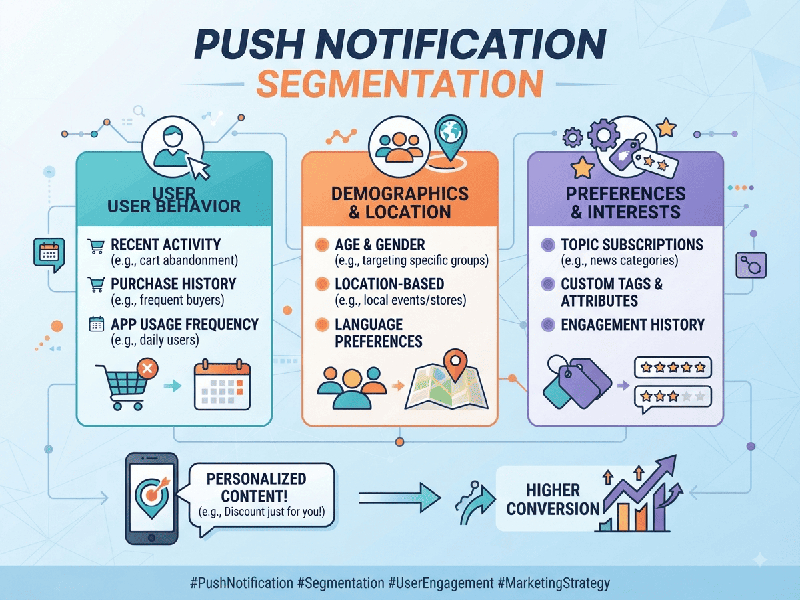
Push Notification Segmentation
Push Notification Segmentation is the practice of dividing your
user base into distinct, targeted groups based on shared characteristics,
behaviors, or preferences. Instead of broadcasting a single
"one-size-fits-all" message to your entire audience, segmentation
ensures that each push notification delivers relevant, context-aware value to
the right user at the right time.
Why Segmentation Matters
- Higher Engagement &
Click-Through Rates (CTR): Relevant messages speak directly to a user's current
needs, driving significantly higher interaction compared to generic
blasts.
- Reduced App Uninstalls &
Opt-Outs:
Irrelevant notifications are the leading cause of users turning off push
permissions or deleting apps. Segmentation prevents notification fatigue.
- Improved Conversion Rates: Tailored promotions, localized
alerts, and behavior-driven reminders naturally lead to higher purchase
rates, sign-ups, or goal completions.
- Stronger Personalization: It shifts your communication
from transactional broadcasting to a personalized user journey.
Core Types of Push Segmentation
To build an effective strategy, user bases are
typically segmented across four primary dimensions:
1.
Behavioral Segmentation (Most Effective)
o Based on actions taken (or not taken)
within the app.
o Examples: Cart abandoners, users who viewed a
specific product category, inactive users (dormant for 30+ days), or power
users who complete daily streaks.
2.
Demographic Segmentation
o Based on user profile attributes.
o Examples: Age, gender, language spoken, or
income bracket (where applicable).
3.
Geographic (Location-Based) Segmentation
o Based on physical location, region,
or proximity.
o Examples: Timezone-optimized delivery,
country-specific currency/deals, or geofenced push alerts triggered when a user
enters a specific retail area.
4.
Device & Technical Segmentation
o Based on the hardware or software
environment.
o Examples: iOS vs. Android users, app version
installed, or network connectivity status.