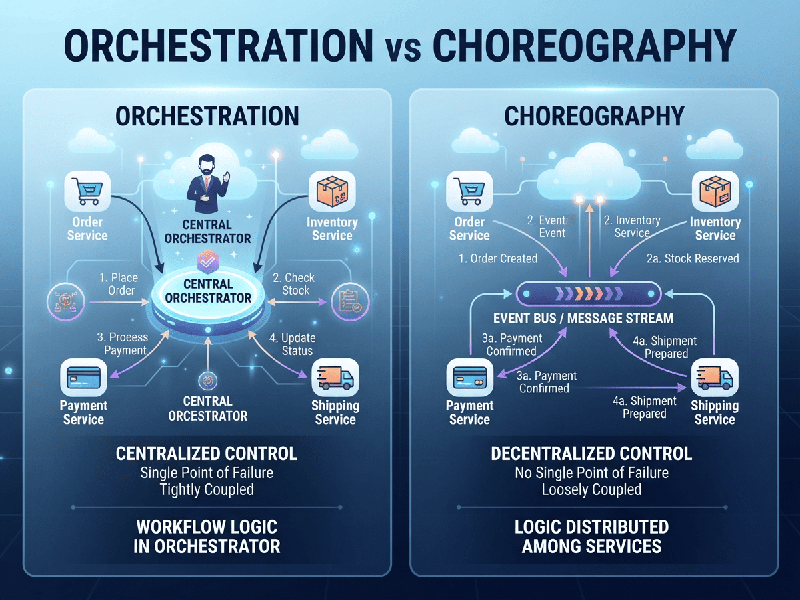
Orchestration vs Choreography in Cloud Apps
In cloud-native applications and microservices
architectures, Orchestration and Choreography are two different
approaches to coordinating how multiple services communicate and execute
workflows.
1. Orchestration (The Conductor)
In orchestration, a central coordinator (the
orchestrator) directs the interactions and decision-making between services.
Think of it like a conductor leading an orchestra—every musician looks to the
conductor to know when to play.
- How it works: Service A tells the
Orchestrator, "I'm done." The Orchestrator then explicitly calls
Service B, waits for a response, and then calls Service C. If something
fails, the Orchestrator handles the error handling and rollbacks.
- Common Tools: AWS Step Functions, Temporal,
Netflix Conductor, Zeebe.
- Pros:
o Clear, centralized view of business
logic and workflows.
o Easier to implement complex error
handling, retries, and compensation transactions (Sagas).
- Cons:
o The orchestrator can become a bottleneck
or a single point of failure.
o Can lead to a "God service"
anti-pattern if too much business logic gets centralized.
2. Choreography (The Dancers)
In choreography, there is no central controller.
Instead, services cooperate by listening to events and reacting to them
independently. Think of it like dancers in a flash mob—each dancer knows their
routine and reacts to what the dancer next to them is doing.
- How it works: Service A performs an action
and publishes an event (e.g., OrderPlaced). Service B and Service C are
listening for that event. When they hear it, they automatically perform
their respective tasks without anyone telling them to do so.
- Common Tools: Apache Kafka, RabbitMQ, AWS
EventBridge, Pub/Sub systems.
- Pros:
o Extremely loose coupling;
services are independent and highly scalable.
o Adding a new service is easy—it just
subscribes to the existing event stream.
- Cons:
o Difficult to trace end-to-end
execution paths (no single place shows the whole workflow).
o Error handling, distributed
transactions, and debugging can become complex as the system grows.