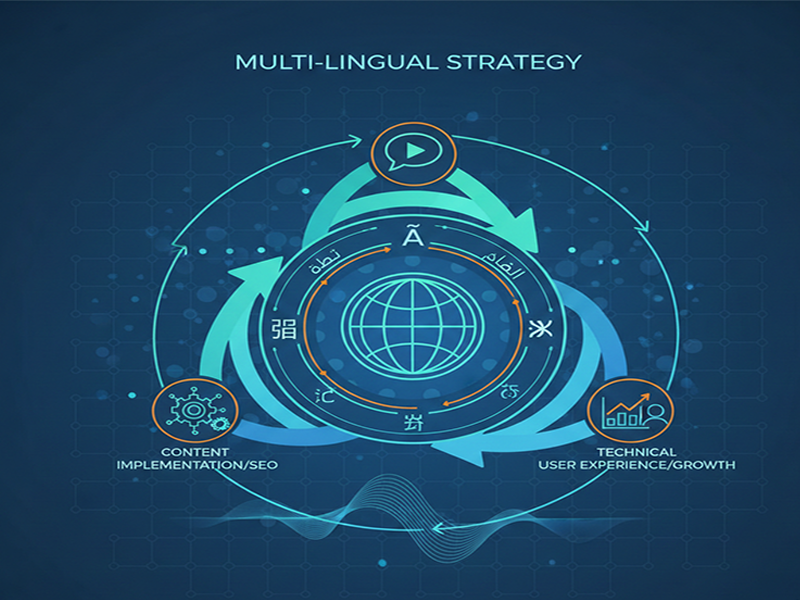
Multi-Lingual Website Strategy
A
successful multi-lingual website strategy focuses on making
your brand accessible, culturally relevant, and discoverable across different
global markets. It is more than just literal translation; it requires a deep
commitment to localization and technical optimization.
1.
Strategic Foundations
- Market Prioritization: Research your existing traffic
using tools like Google Analytics to identify which regions
already engage with your brand.
- Localization vs. Translation: Move beyond word-for-word
translation. Localization adapts
your message to local idioms, cultural norms, and specific consumer
behaviors.
- Business Operations: Ensure your internal
infrastructure (e.g., customer support, billing, and logistics) can
actually serve the markets you are targeting in their native
languages.
2.
Technical SEO & Infrastructure
- URL Structure: Choose a clear format for
language-specific pages:
- Subdirectories (e.g., ://site.com):
Easiest to manage and consolidates domain authority.
- Subdomains (e.g., es.site.com):
Good for larger, regionally distinct site structures.
- ccTLDs (e.g., site.es):
strongest signal for local search engines but most expensive to maintain.
- Hreflang Tags: Implement hreflang attributes in your HTML or sitemaps to
tell search engines which language version of a page to serve to specific
users.
- Sitemap Management: Submit separate XML sitemaps for each language to ensure search
engines crawl and index all variations correctly.
3.
Content & Design Best Practices
- Language Switchers: Place a prominent,
easy-to-find toggle (often in the header or footer). Use the language's
native name (e.g., "Deutsch" instead of "German")
rather than just flags, which can be ambiguous.
- Adaptive Design: Plan for text
expansion; for example, German text can be 30–40% longer than English,
which might break rigid layouts. Ensure your site supports Right-to-Left
(RTL) scripts like Arabic or Hebrew if necessary.
- Visual Relevance: Swap images and icons to match
local cultural context. A "thumbs up" icon is positive in the
West but can be offensive in parts of the Middle East.
- Keyword Research: Do not just translate
keywords. Use tools like Semrush or Ahrefs to find
what local users are actually searching for.
4.
Maintenance & Performance
- Content Synchronization: Establish a workflow to ensure
updates to the primary site are quickly reflected in all translated
versions to avoid "content drift".
- Performance (CDN): Use a Content Delivery Network to ensure your site
loads fast for international users, as high latency negatively impacts SEO
and conversion.
- Testing: Have native speakers
conduct localization testing to catch awkward phrasing or
technical bugs like broken local links.