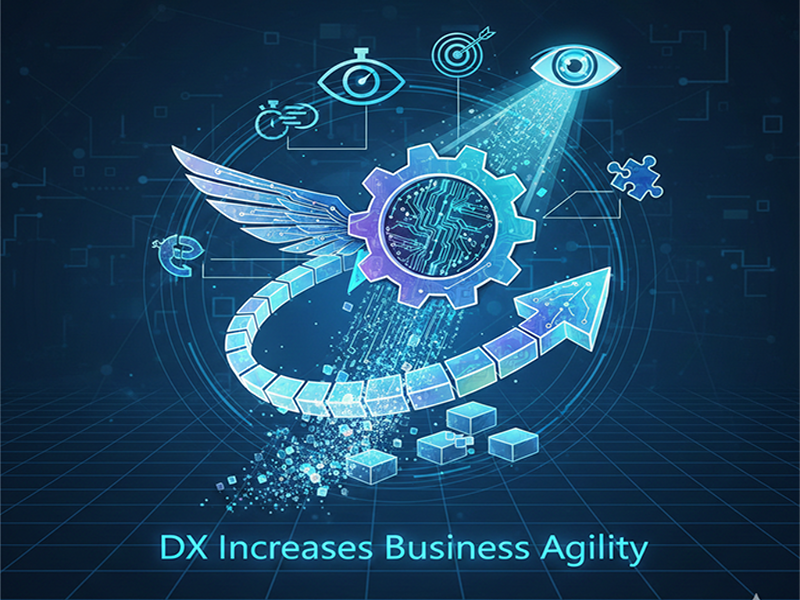
How DX Increases Business Agility
Digital
Transformation (DX) is more than just upgrading software; it is the process of
reimagining how a business operates using technology as the backbone. By
integrating digital tools into every area of a company, organizations can
respond to market changes faster and more effectively.
1. Data-Driven Decision Making
Traditional
businesses often rely on "gut feeling" or delayed quarterly reports.
DX implements real-time data analytics and AI, allowing leaders to:
- Pivot quickly based on live market
trends.
- Predict customer behavior using machine learning
models.
- Reduce risk by testing strategies
through digital simulations before a full rollout.
2.
Modernizing Infrastructure with Cloud Computing
Legacy
systems are often "brittle" and slow to change. Moving to the cloud
increases agility by:
- Scalability: Instantly increasing
server capacity during peak demand without buying hardware.
- Remote Collaboration: Allowing teams to work
from anywhere with synchronized data.
- Lowering Barriers to Entry: Accessing enterprise-grade
tools (SaaS) on a subscription basis rather than large upfront
investments.
3.
Streamlining Operations via Automation
Manual,
repetitive tasks are the enemy of speed. DX introduces Robotic Process
Automation (RPA) and integrated workflows which:
- Eliminate Bottlenecks: Tasks like invoice
processing or customer onboarding happen in seconds, not days.
- Free Up Talent: Employees can focus on
high-value creative problem-solving instead of data entry.
- Improve Accuracy: Automated systems reduce
human error, which prevents costly rework.
4.
Enhancing the Customer Experience (CX)
In an agile
business, the distance between the "customer's need" and the
"company's solution" is very short. DX enables this through:
- Omnichannel Support: Engaging customers across
social media, apps, and web seamlessly.
- Rapid Feedback Loops: Using digital tools to
gather customer sentiment instantly and adjusting products in real-time.
5.
Fostering an "Agile" Culture
DX requires
a shift in mindset. Because digital tools make it easier to experiment,
companies develop a culture that:
- Embraces Iteration: Launching a "Minimum
Viable Product" (MVP) and improving it based on data.
- Breaks Down Silos: Integrated platforms (like
Slack, Jira, or ERPs) ensure that Marketing, Sales, and Engineering are
all looking at the same information.