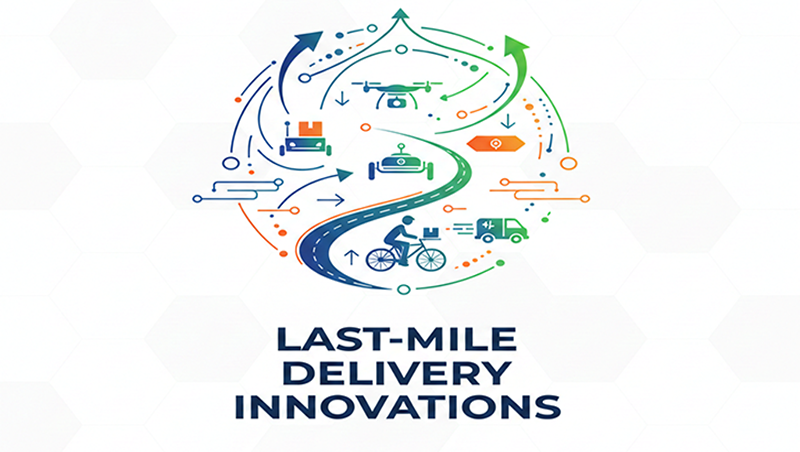
Last-Mile Delivery Innovations
last-mile
delivery innovations are focused on hyper-efficiency, sustainability, and
ultra-fast fulfillment to manage costs that now account for 40–53% of
total logistics spending.
1.
AI-Driven Orchestration & Automation
- Dynamic AI Route Optimization: Moving beyond static
paths, AI now processes real-time data—including weather, local traffic
patterns, and sudden roadblocks—to adjust delivery routes instantly. This
can reduce fuel consumption by 20% and delivery times
by 25%.
- Predictive Analytics & ETAs: Machine learning models
identify potential bottlenecks before they happen, improving ETA accuracy
by 30-40% and reducing failed first-attempt deliveries,
which cost an average of $17.78 each.
- Generative AI for Operations: Retailers are utilizing
Gen-AI for predictive demand forecasting and automated customer
communication to handle the "Where Is My Order?" (WISMO) queries
more efficiently.
2.
Autonomous and Aerial Tech
- Delivery Robots: Highly automated sidewalk
robots (e.g., REWE’s "Lieferbot 2.0") are operating in pilot
zones in major cities, handling small packages at speeds of 6 km/h.
- Drone Delivery: Major players like Walmart
and Amazon have expanded drone delivery for lightweight, time-sensitive
items like medicines and groceries, often reaching customers in
under 10–30 minutes in specific urban clusters.
- Modular Autonomous Vehicles: Startups like Intermode are
developing modular electric vehicle platforms that can navigate sidewalks,
bike lanes, and road shoulders to bypass traditional traffic.
3.
Decentralized Fulfillment Models
- Urban Micro-Fulfillment Centers
(MFCs): Companies
are converting small urban spaces (3,000–15,000 sq ft) into automated
hubs. These are situated within 3–5 miles of customers,
enabling 30-minute to 2-hour delivery windows.
- Store-as-a-Hub: Retailers are increasingly
using physical storefronts as mini-distribution centers for
"ship-from-store" models, significantly shortening the distance
of the "final mile".
4. Green
Logistics & Sustainability
- Electric Fleet Transition: Major carriers have scaled
EV adoption; Amazon has deployed over 10,000 electric vans across
1,800 cities.
- Cargo Bikes & Scooters: For dense urban centers
with restricted vehicle access, zero-emission e-cargo bikes have become a
standard mode for agile, traffic-free deliveries.
- Hydrogen-Powered Transport: Heavy-duty regional
distribution is seeing the implementation of hydrogen fuel-cell trucks to
achieve ranges over 400 km with zero emissions.
5.
Out-of-Home (OOH) Infrastructure
- Smart Parcel Lockers: To eliminate "no one
home" failed deliveries, secure, monitored electronic lockers
(e.g., M-loka) are expanding in residential complexes and
transit hubs.
- Alternative Pickup Points: Retailers are offering
centralized pickup locations, reducing the need for door-to-door stops and
increasing route density.