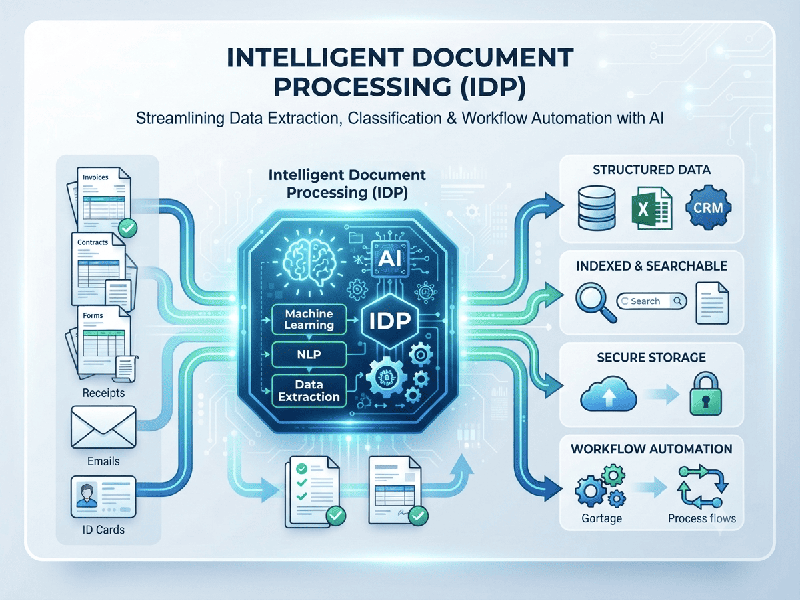
Intelligent Document Processing (IDP)
Intelligent Document Processing (IDP) is an advanced, AI-driven technology
used to capture, classify, extract, and validate data from structured,
semi-structured, and unstructured documents (such as invoices, PDFs, emails,
forms, and contracts).
Unlike traditional Optical Character Recognition
(OCR), which simply converts images of text into machine-readable text, IDP
uses Artificial Intelligence (AI), Machine Learning (ML), Natural Language
Processing (NLP), and Deep Learning to understand the context and
meaning of the data.
How IDP Works (The Typical Workflow)
1.
Document Ingestion: Collecting documents from multiple channels (emails, mobile apps,
scanners, cloud storage, or APIs).
2.
Pre-Processing:
Cleaning images by removing noise, de-skewing, and enhancing resolution for
better text recognition.
3.
Classification:
Automatically identifying what kind of document it is (e.g., an invoice, a bill
of lading, or a bank statement) based on its layout and text patterns.
4.
Data Extraction: Extracting key-value pairs, line items, tables, and signatures using AI
and OCR.
5.
Validation & Cross-Checking: Validating the extracted data against internal databases,
rules, or business logic (e.g., matching an invoice purchase order number
against an ERP system).
6.
Human-in-the-Loop (HITL): Flagging low-confidence data for human review, allowing the
system to learn from corrections over time.
7.
Integration: Exporting
structured data (JSON, XML, CSV) directly into enterprise systems like ERP,
CRM, or financial databases.
Key Benefits of IDP
- Massive Cost and Time Savings: Eliminates manual data entry,
reducing processing times from days to seconds and lowering operational
costs significantly.
- High Accuracy: Minimizes human error through
automated data validation and machine learning feedback loops.
- Handles Unstructured Data: Easily processes complex,
messy, or varying formats that traditional automation tools fail to read.
- Improved Compliance and
Security:
Maintains audit trails, tracks document histories, and ensures sensitive
data is handled securely.
- Scalability: Easily scales to handle sudden
surges in document volume without requiring a larger administrative
workforce.
Common Use Cases
- Finance & Accounting: Automated invoice processing,
accounts payable, and receipt management.
- Supply Chain & Logistics: Processing bills of lading,
customs declarations, shipping receipts, and purchase orders.
- Banking & Lending: Automating loan applications,
mortgage underwriting, and KYC (Know Your Customer) compliance
verifications.
- Human Resources: Automated resume screening,
candidate matching, and employee onboarding paperwork.
- Legal: Contract analysis, extracting
critical legal clauses, and e-discovery categorization.