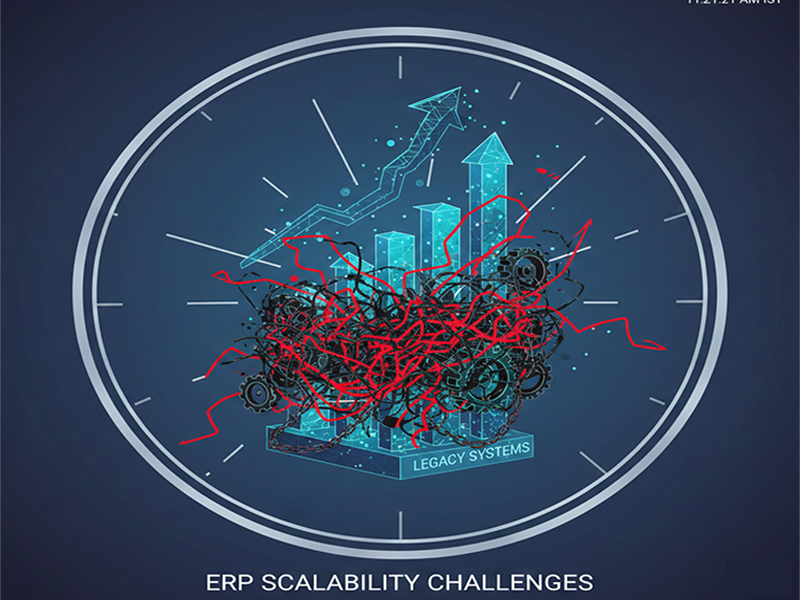
ERP Scalability Challenges
Scalability
challenges in Enterprise Resource Planning (ERP) systems occur when a platform
that initially served a company well becomes a bottleneck during periods of
rapid growth. These challenges are often categorized into technical,
operational, and financial dimensions.
Primary
ERP Scalability Challenges
- Performance Degradation: As data volume and
transaction counts increase, legacy or poorly configured systems often
suffer from high latency and slow query speeds.
- Technical Debt and Monolithic
Architecture: Traditional
ERPs are often monolithic, meaning all components are tightly coupled.
Scaling such a system requires replicating the entire application, which
is inefficient and costly compared to modern microservices architectures.
- Data Governance Issues: Growth often leads to
inconsistent data models and duplicated records, especially in
multi-entity environments. Without standardized master data
protocols, the system cannot provide a "single source of truth".
- Integration Hurdles: Expanding businesses often
add new third-party tools (e.g., e-commerce or CRM). Inflexible ERPs may
lack the necessary APIs, forcing manual data transfers or expensive custom
integrations that slow down operations.
- Customization Overload: Excessive custom code
makes it difficult to apply vendor updates or scale to new regions with
different regulatory needs. This creates a "growth wall" where
the cost of maintaining modifications exceeds the value of the system.
- Punitive Licensing Models: Some vendors use pricing
structures that become exponentially more expensive as user counts grow,
eroding the profit margins that scaling was intended to improve.
Strategies
for Future-Proofing
- Adopt Cloud-Native Solutions: Cloud ERPs offer elastic
computing, allowing resources to scale up or down dynamically based on
demand.
- Modular Implementation: Using a modular design allows companies to add specific
functionalities (like international tax modules) only when needed,
avoiding unnecessary system bloat.
- Two-Tier ERP Strategy: Large global enterprises
often use a "Tier 1" system for corporate headquarters and
"Tier 2" (typically cloud-based) for smaller subsidiaries to
manage local compliance without overcomplicating the main system.
- Automate via AI and RPA: Integrating AI-driven
analytics and Robotic Process Automation (RPA) helps handle
high-volume repetitive tasks without requiring a proportional increase in
headcount.