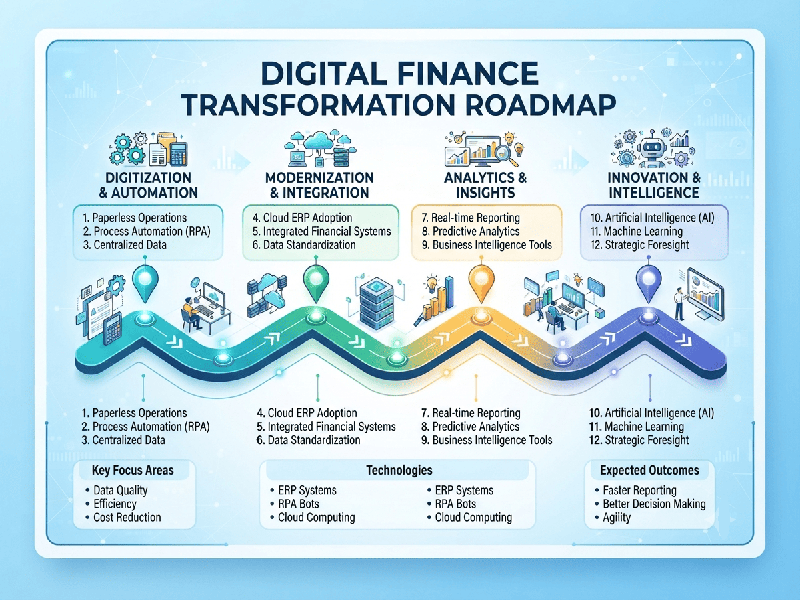
Digital Finance Transformation Roadmap
A digital finance transformation roadmap is a
strategic, phased blueprint that guides an organization from traditional,
manual accounting and finance operations to a modern, data-driven, and
automated digital ecosystem. It integrates advanced enterprise technologies—such
as cloud ERPs, AI/ML analytics, and automated workflows—into the finance
function to improve strategic decision-making, speed up reporting, and reduce
operational costs.
Key Phases of the Roadmap
Phase 1: Assessment, Vision, and Strategy
- Objective: Establish a baseline of current
financial processes, identify operational bottlenecks, and define clear
business goals.
- Key Activities:
o Audit existing legacy systems, data
silos, and manual spreadsheets.
o Define key performance indicators
(KPIs) for success (e.g., reduction in close cycle time, forecast accuracy).
o Align finance strategy with broader
enterprise digital transformation goals.
Phase 2: Foundation & Core Modernization (Cloud
Migration)
- Objective: Move core financial systems to
scalable, cloud-based infrastructure to establish a single source of
truth.
- Key Activities:
o Implement or upgrade to modern cloud
ERP systems (e.g., SAP, Oracle, Microsoft Dynamics).
o Migrate general ledger, accounts
payable (AP), and accounts receivable (AR) to secure cloud platforms.
o Cleanse, standardize, and centralize
master financial data.
Phase 3: Process Automation & Efficiency
- Objective: Eliminate repetitive manual
tasks and accelerate transaction processing.
- Key Activities:
o Deploy Robotic Process Automation
(RPA) for routine invoice processing, bank reconciliations, and expense
management.
o Implement automated workflows for
purchase-to-pay (P2P) and order-to-cash (O2C) cycles.
o Digitize document management and
audit trails.
Phase 4: Advanced Analytics & Intelligent
Forecasting
- Objective: Shift finance from a reactive
reporting function to a proactive, strategic advisory partner using
predictive insights.
- Key Activities:
o Implement modern Enterprise
Performance Management (EPM) tools for budgeting, planning, and forecasting
(FP&A).
o Integrate AI and machine learning
models for cash flow forecasting, anomaly detection, and risk assessment.
o Build real-time financial dashboards
and self-service analytics for executive leadership.
Phase 5: Continuous Optimization & Cultural Change
- Objective: Foster a culture of continuous
improvement, data literacy, and technological adaptation.
- Key Activities:
o Upskill finance teams in data
interpretation, modern software navigation, and strategic advisory.
o Establish governance models to
maintain data security, regulatory compliance, and system performance tuning.
o Continuously review automated
processes and adopt emerging technologies (such as generative AI for financial
reporting summaries).