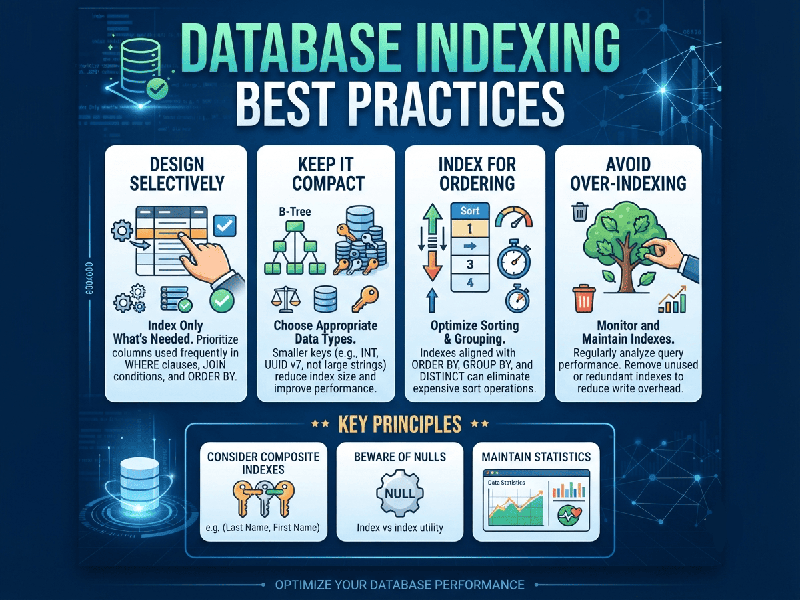
Database Indexing Best Practices
Database indexing is one of the most effective ways to
improve query performance. However, improper indexing can degrade write
performance and consume unnecessary storage.
1. Strategic Index Creation
- Index Foreign Keys: Always index columns used in
foreign key constraints. This speeds up JOIN operations and prevents full
table scans during cascading deletes or updates.
- Target High-Selectivity Columns: Create indexes on columns with
a high degree of uniqueness (e.g., user IDs, email addresses).
Low-selectivity columns (e.g., a boolean is_active flag with only two
values) rarely benefit from traditional B-tree indexes unless combined in
a composite index.
- Prioritize WHERE, JOIN, and
ORDER BY Clauses: Focus index creation on columns frequently filtered (WHERE), joined
(ON), or sorted (ORDER BY) in your most critical queries.
2. Composite (Multi-Column) Indexing
- Understand the Leftmost Prefix
Rule: A
composite index on (A, B, C) can be used for queries filtering on A, A and
B, or A, B, and C. It cannot efficiently be used for queries
filtering only on B or C.
- Order Columns Correctly: Place columns with equality (=)
checks first in a composite index, followed by columns used for range
queries (>, <, BETWEEN).
3. Avoiding Anti-Patterns
- Limit the Number of Indexes per
Table: Every
index must be updated whenever a INSERT, UPDATE, or DELETE statement is
executed. A good rule of thumb is to keep active indexes to 3 to 5 per
table, depending on write frequency.
- Avoid Indexing Frequently
Modified Tables:
If a table experiences high-volume writes with relatively few reads (e.g.,
logging or real-time event tracking tables), minimize indexes to maximize
write throughput.
- Do Not Index Small Tables: For tables with only a few
dozen or hundred rows, the database engine can scan the entire table
faster than looking up an index. Let the query planner do a sequential
scan.
4. Advanced Indexing Techniques
- Use Partial (Filtered) Indexes: If you only query a subset of
data frequently (e.g., active users where status = 'active'), create a
partial index that only includes those rows. This saves disk space and
memory.
- Consider Covering Indexes: Include all columns requested
by a frequent query in the index (often via INCLUDE clauses in databases
like PostgreSQL or SQL Server). This allows the database to satisfy the
query entirely from the index without looking up the table data rows
(Index-Only Scan).
5. Maintenance and Monitoring
- Remove Unused Indexes: Periodically audit your
database to identify and drop redundant or unused indexes that consume
storage and slow down writes. Most relational databases provide system
views to track index usage statistics.
Rebuild or Reorganize Fragmented Indexes: Over time, heavy DML operations cause index fragmentation.