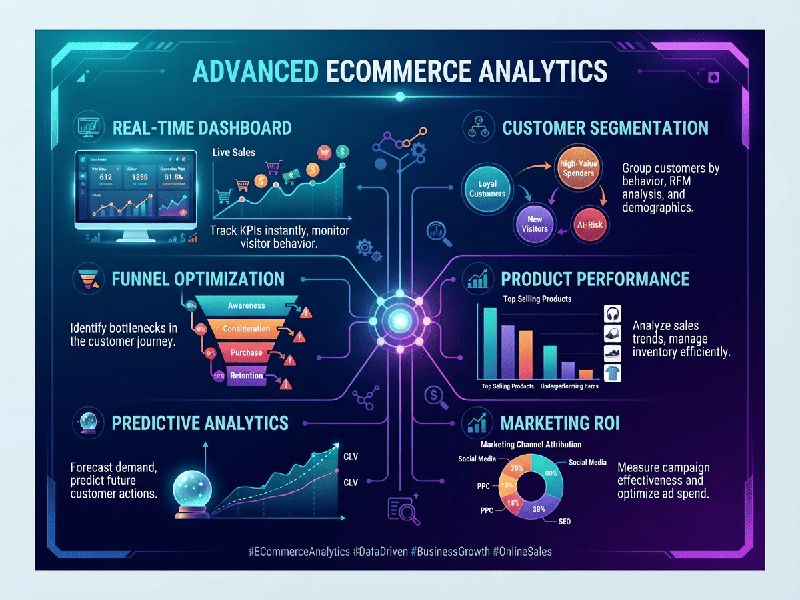
Advanced eCommerce Analytics
An Advanced eCommerce Analytics framework moves
beyond basic traffic tracking and total revenue metrics to uncover granular
insights into customer behavior, profitability, and lifetime value. By
leveraging predictive modeling and deep data attribution, businesses transition
from reactive reporting to proactive revenue optimization.
1. Core Advanced Metrics Beyond the Basics
- Customer Lifetime Value (LTV): Measures the total net profit a
business extracts from a customer over their entire relationship. Accurate
LTV modeling accounts for gross margins, return rates, and retention
costs, helping you determine how much you can afford to spend on customer
acquisition (CAC).
- Customer Acquisition Cost (CAC)
Payback Period:
Calculates the exact number of months it takes for a customer's cumulative
gross margin to cover the cost of acquiring them. Shorter payback periods
unlock healthier cash flow.
- Cohort Analysis: Groups customers based on
shared characteristics (such as the month they made their first purchase
or acquisition channel) to track retention, repeat purchase rates, and
revenue degradation over time.
- Cart Abandonment &
Micro-Conversion Funnels: Analyzes drop-off points not just at checkout, but
across granular micro-steps (e.g., adding to wishlist, viewing shipping
calculators, applying discount codes) to isolate UX friction.
2. Predictive Analytics & Machine Learning Models
- Chum Prediction Modeling: Machine learning algorithms
evaluate behavioral signals—such as declining visit frequency, drops in
average order value (AOV), or decreased engagement with email campaigns—to
identify customers at high risk of churning before they leave.
- Product Recommendation Engines: Uses collaborative filtering
and neural networks to power real-time cross-sell and upsell
recommendations on product detail pages and checkout screens, directly
inflating AOV.
- Demand Forecasting &
Inventory Turnover Modeling: Predicts seasonal surges, regional demand shifts, and
optimal reorder points to prevent stockouts of high-velocity items while
minimizing warehouse holding costs.
3. Attribution Modeling & Marketing Mix
Optimization
- Multi-Touch Attribution (MTA): Moves away from simplistic
"Last-Click" attribution by evaluating every touchpoint in a
customer’s journey (e.g., social ads, organic search, email newsletters,
retargeting) to credit revenue distribution fairly across marketing
channels.
- Marketing Mix Modeling (MMM): Uses econometric time-series
analysis to measure the impact of both digital and offline marketing
investments against external variables like seasonality and economic
indicators, ensuring budget allocation maximizes overall profitability.
4. Technical Architecture for Advanced Analytics
- Customer Data Platforms (CDP): Centralizes first-party
customer data from your website, mobile app, ERP, and CRM into a single,
unified customer profile.
- Server-Side Tracking & Data
Warehouses: Implements
server-side tagging (via Google Tag Manager or custom setups) to bypass
ad-blockers and iOS privacy restrictions, piping clean, compliant event
streams directly into cloud data warehouses like BigQuery, Snowflake, or
Redshift for deep SQL-based analysis.