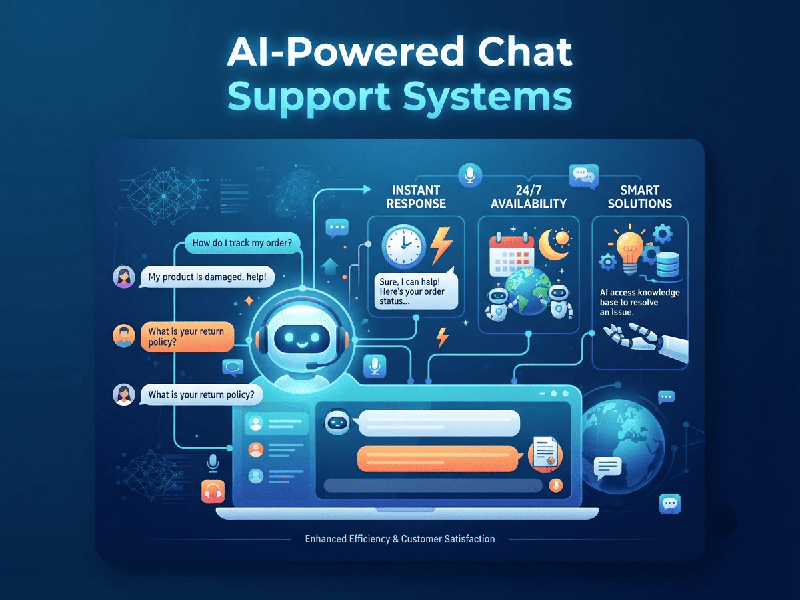
AI-Powered Chat Support Systems
AI-Powered Chat Support Systems leverage advanced Natural Language
Understanding (NLU), Large Language Models (LLMs), and retrieval infrastructure
to handle customer and internal queries dynamically.
Unlike rigid, legacy rule-based bots that rely on
static decision trees, modern systems interpret open-ended human phrasing,
parse multi-step instructions, and integrate deeply with core business systems
to execute automated workflows.
Core Architecture Layers
Modern enterprise chat support systems rely on a
modular, multi-layered framework to ensure accuracy, security, and scalability:
- Channel Layer: The user-facing interface,
including web widgets, mobile apps, social messaging apps (like WhatsApp),
and internal workspace tools (like Slack or Microsoft Teams).
- Orchestration & Dialogue
Management: The
central engine that coordinates context, manages session state, and
decides whether to retrieve information, invoke an API tool, or escalate
to a human.
- Retrieval-Augmented Generation
(RAG) Layer:
Connects the LLM to verified enterprise data sources (knowledge bases,
documentation, policy manuals) to ensure answers are grounded in factual
reality rather than hallucinations.
- Execution & Action Engine: A deterministic execution layer
capable of safely calling APIs—such as updating a ticket status,
processing a refund check, or fetching customer account details from a CRM
or ERP.
Key Capabilities & Modern Trends
- Knowledge-Grounded Answers: Systems pull directly from
verified articles, release notes, and internal policies, dramatically
reducing incorrect or hallucinated guidance.
- Multimodal Issue Capture: Users can upload screenshots,
screen recordings, or error logs directly into the chat flow, allowing the
AI to parse UI states and package clean bug reports for engineering teams.
- Context-Preserving Human
Handoffs: When
a query exceeds the bot's automation capability, the system transfers the
full conversation history, user sentiment, and prior troubleshooting
attempts to a human agent seamlessly without forcing the user to repeat
themselves.
- Hybrid Execution Boundaries: Balancing open-ended generative
conversation with strict rules for high-stakes tasks (e.g., billing logic,
security verification, or data privacy parameters).