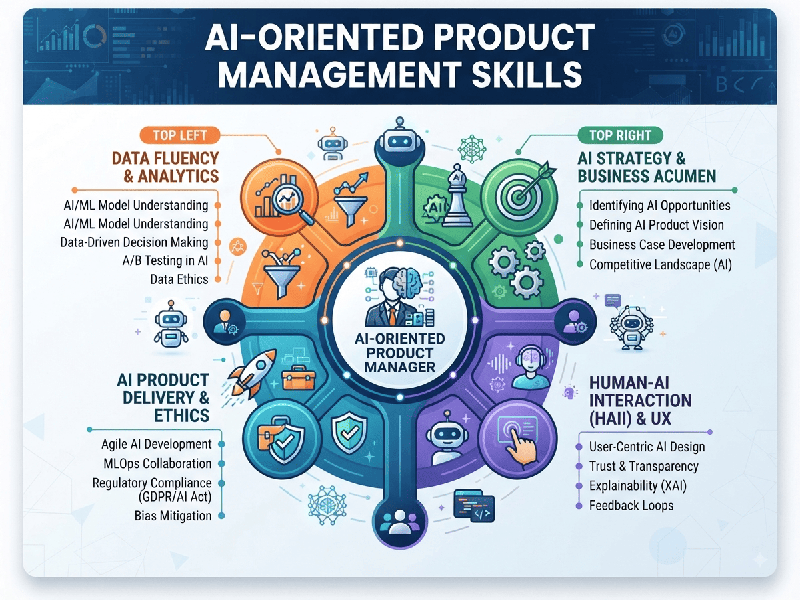
AI-Oriented Product Management Skills
AI-Oriented Product Management bridges traditional
software product management with the unique deterministic-to-probabilistic
nature of Artificial Intelligence and Machine Learning (ML) systems.
1. AI/ML Technical Literacy
- Model Understanding: Comprehending the fundamentals
of Large Language Models (LLMs), Generative AI, Computer Vision, and
Predictive Modeling without necessarily writing production code.
- Data Pipelines & Quality: Knowing how data collection,
cleaning, labeling, and vector embedding impact model accuracy and system
hallucinations.
- Evaluation Metrics: Moving beyond traditional
software KPIs (uptime, latency) to track AI-specific metrics like
Precision, Recall, F1-Score, Perplexity, and BLEU/ROUGE scores.
2. Probabilistic Product Discovery & UX
- Managing Uncertainty: Designing products where
outputs are non-deterministic and probabilistic rather than strictly
deterministic (handling errors gracefully when the model is
"wrong").
- Prompt Engineering & Context
Windows:
Understanding how context, system prompts, and Retrieval-Augmented
Generation (RAG) architecture shape user experience and output relevance.
- Human-in-the-Loop (HITL) Design: Building seamless feedback
loops that allow users to correct, rate, or fine-tune AI outputs to
improve future model performance.
3. AI Strategy & Value Alignment
- Build vs. Buy vs. Partner: Evaluating whether to fine-tune
open-source models, build custom models from scratch, or leverage
third-party APIs (e.g., OpenAI, Anthropic, Google Cloud AI).
- Cost-to-Value Optimization: Managing the high inference and
compute costs associated with running AI models at scale against the
actual business ROI.
- Use-Case Validation: Identifying problems where AI
provides a genuine 10x multiplier over traditional heuristics or
deterministic software.
4. Ethics, Governance, and Compliance
- Bias and Fairness: Proactively auditing training
data and model outputs to mitigate demographic, socioeconomic, or cultural
bias.
- Data Privacy & Security: Ensuring compliance with data
protection regulations (such as GDPR or India’s DPDP Act) when feeding
proprietary data into enterprise or third-party AI models.
- Transparency and Explainability: Establishing mechanisms to make
"black box" AI decisions interpretable and trustworthy for
end-users.