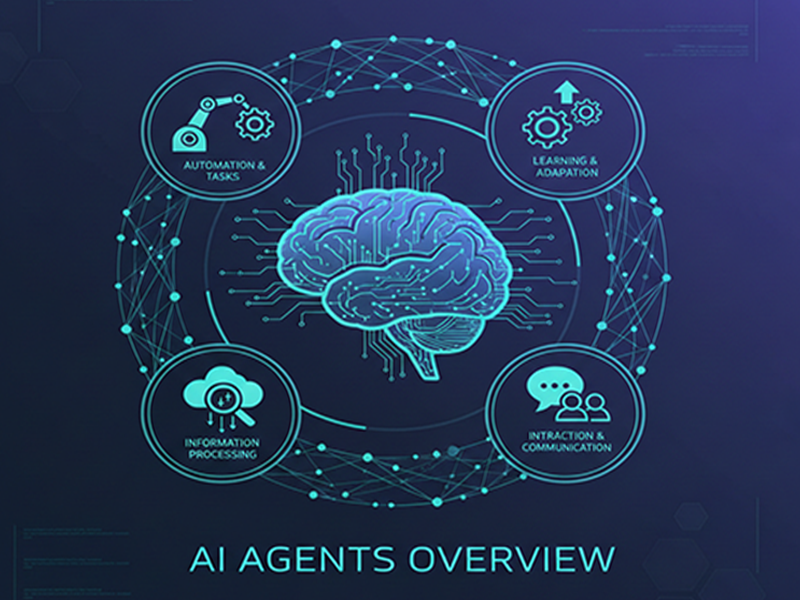
AI Agents Overview
AI Agents
(also known as "agentic AI") have transitioned from simple
conversational tools to autonomous digital coworkers. Unlike
traditional chatbots that require continuous prompts, these agents can reason,
plan, and execute multi-step tasks independently to achieve a user's defined
goal.
Core
Characteristics
- Autonomy: AI agents function with
little human input, making their own decisions within set boundaries.
- Reasoning and Planning: Utilizing advanced models
like Gemini 3 or GPT-5, these agents break
down complex tasks into smaller parts.
- Actionable Execution: Agents do more than just
communicate; they use APIs to interact with CRMs, ERPs, and other
enterprise systems.
- Continuous Learning: They use feedback loops,
also known as Reinforcement Learning, to improve their accuracy and
strategies.
Key Types
in 2026
1.
Multi-Agent Systems (MAS): These are networks of specialized agents, for example,
a "Researcher" agent and a "Writer" agent, that work
together to solve larger issues.
2.
Computer-Using Agents (CUAs): These systems can interact with software GUIs in the
same way humans do, by clicking, typing, and scrolling through older
applications.
3.
Vertical/Specialized Agents: These agents are industry-specific and trained for
critical areas such as Healthcare (diagnostics/triage)
or Finance (fraud detection/risk assessment).
4.
Embodied AI: Agents
that are integrated with physical hardware, such as autonomous warehouse robots
or smart home appliances.
Business
Impact
- Adoption Rate: By 2026, roughly 80%
of enterprise applications are expected to include AI agents.
- Economic Value: Analysts predict that
agentic AI will generate hundreds of billions in economic value by 2028
through large productivity gains.
- Workforce Evolution: Teams made up of both
humans and AI agents are becoming common, with humans focusing on
supervisory and strategic roles.